CPA survey reveals 18th consecutive quarter of growth

The Construction Products Association’s Construction Trade Survey for Q3 shows that despite rising costs and diverging performance across sectors, the industry extended its run of growth to 18 quarters.

The survey of main contractors, SME builders, civil engineering firms, product manufacturers and specialist contractors found that the construction supply chain reported increases in sales, output and workloads in the quarter, driven by increased demand in private housing, repair and maintenance and infrastructure.

Net balances for enquiries and expected product sales for the year ahead remained muted, however, and contractors’ order books were sustained by work in only three sectors: private housing, housing R&M and non-housing R&M. New orders were reported lower in sectors such as commercial, industrial and public non-housing, which account for one-third of construction output.

The effects of Sterling’s depreciation in the second half of 2016, following the EU Referendum, are still pervasive, with 92% of main contractors, 85% of heavy side manufacturers and all light side manufacturers reporting a rise in raw materials costs in Q3. In spite of this, only a small proportion of contractors are increasing tender prices and, as a result, 31% of main contractors reported a fall in margins, the worst balance in five years.

Commenting on the survey, Rebecca Larkin, senior economist at the CPA, said: “This 18th consecutive quarter of growth reported by the industry stands in contrast to the construction recession in preliminary GDP data from the ONS. There is a clear division in fortunes across sectors, however, with weakness in the commercial and industrial sectors offset by strength in new build private housing, a sector where demand and confidence remain supported by the Help to Buy equity loan.

“In common with the wider economy, the construction industry continues to experience cost inflation, particularly for raw materials. A clear consequence of the supply chain trying to absorb these higher costs is the fall in contractors’ profit margins since the start of the year. Combined with a smaller pipeline of upcoming work in some key sectors, the survey’s more mixed view on near-term industry prospects is not surprising.”

Suzannah Nichol, chief executive of Build UK, said: “The latest Construction Trade Survey result highlights the industry’s continued growth, contrary to ONS’s statistics, with both contractors and specialist contractors reporting a rise in output during Q3. However, a lack of required skills remains a concern, with labour availability issues continuing to impact on contractors’ business performance. Build UK believes industry needs to recruit, train and retain a skilled workforce and we are working with members, government and other key stakeholders to ensure that this remains a key priority.”

CECA director of external affairs, Marie-Claude Hemming, said: “It is good news that our members see growth in infrastructure, to the benefit of businesses and communities across the country. However, uncertainty continues to act as a drag on the ability of the construction industry more generally to boost the economy. Ahead of the Autumn budget, we are calling on the UK Government to commit to the projects outlined in the National Infrastructure Delivery Plan, to secure the foundations of a strong economy, drive productivity, and deliver post-Brexit growth.”

The post CPA survey reveals 18th consecutive quarter of growth appeared first on Glass & Glazing Products Magazine (GGP).

Four NFA shortlisting for Customade Group

Celebrations have been taking place at Customade Group as it toasts being named finalist in an incredible four categories in the National Fenestration Awards. Four divisions within the group are up for gongs in the annual independent awards. Atlas Glazed Roof Solutions – the creator of the UK’s finest collection of glazed roof products – is finalist in the ‘Conservatory Roof Fabricator’ category, whilst leading composite door and PVCu door panel manufacturer Virtuoso has reached the shortlist in the ‘Composite and Panelled Doors category’.

Polyframe – the UK’s largest fabricator of PVCu windows, doors and conservatories – has been named as finalist in the ‘Fabricator/Manufacturer’ category and is the only fabricator on the shortlist to offer five PVCu systems. The industry defining aluminium brand REAL Aluminium is hoping to maintain its title of ‘Aluminium Company’ having won the award last year.

The multiple nominations highlight the unmatched capabilities of the recently enhanced Customade Group, which merged with Polyframe earlier this year. The group’s product portfolio now spans across PVC-u and aluminium windows and doors, composite doors, aluminium glazed roof products, sealed glass units and specialist glazing.

Claire Miller, Customade Group’s marketing director, says: “We’re absolutely delighted to be named as quadruple finalists. It’s a fantastic achievement for Customade Group and real industry recognition for the quality of our brands and the amazing teams behind them. These awards are the perfect round-off to a terrific year for the group and we’re looking forward to finding out who the winners are in December.”

Voting is now open to everyone and the finalists with the most votes will be announced in early December. Visit the NFA website – www.fenestrationawards.co.uk – to place your vote.

The post Four NFA shortlisting for Customade Group appeared first on Windows Active Magazine.

MBO for CDW Systems

(Left to Right) Angela Phillips, Jeremy Phillips, Mike Davis, Richard Smith, Martin Rowe and Allan Little

(Left to Right) Angela Phillips, Jeremy Phillips, Mike Davis, Richard Smith, Martin Rowe and Allan Little

Gloucester-based aluminium specialist, CDW Systems, has announced a management buyout.

The existing senior management team of Richard Smith, Angela Phillips, Jeremy Phillips, Allan Little, Martin Rowe and Mike Davis have formed a new holding company, East Manor Group, which will manage its three operating companies, which includes CDW Systems, Clearway Doors & Windows and Designex Cabinets.

Mike Davis, who became managing director at CDW a year ago, said that while the company has been purchased from its group chairman, Jerry Webb, the new owners don’t intend to make any changes operationally to how the business is run on a day to day basis.

According to the new owners of CDW, Jerry will continue to be very active within the business, reviewing the strategic direction and pathway of the company well into the future.

Mike commented: “The management buyout at CDW Systems marks the beginning of the next chapter in the company’s history but we also want to stay true to our company’s long-standing values and standards.

“The six of us have purchased the company from Jerry but we are not planning to implement any major changes. Jerry will remain an important part of the business as a non-executive chairman and we look forward to continuing to benefit from his advice and extensive knowledge of the industry.

“On behalf of the team we’d also like to thank Jerry for this continued commitment to the business and his professionalism and vision in overseeing its success to date.”

Jerry Webb commented: “I’m very pleased that CDW Systems has passed into such experienced and dedicated hands. In my new role, I will continue to meet with customers and suppliers. Since the MBO in late September, I feel I’ve been even more actively involved in the company than I have been in recent years, so I don’t see myself slowing down anytime soon.”

CDW Systems was formed in 1992 and the last 25 years has seen the company expand along with the UK’s growing aluminium industry. Last year, the joint group turnover was reportedly in excess of £10 million.

The post MBO for CDW Systems appeared first on Glass & Glazing Products Magazine (GGP).

Conservatory Installed Values Up By 9% – Palmer

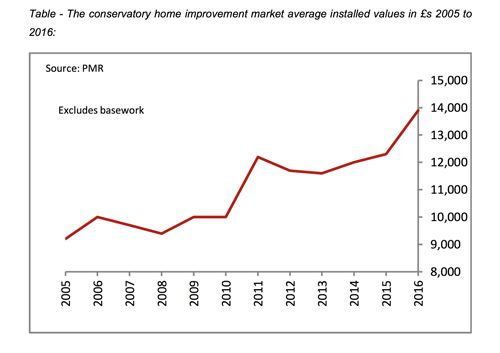
New findings from Palmer Market Research reveal that the total installed value of the UK conservatory market jumped by 9% to £1.05bn last year – the highest level since 2009.

According to the Market for Domestic Conservatories 2017 average installed prices also rose by 12%. The rate of fall in volume also slowed to 1.4% compared to 6% last year.

“Although the market appears to be in long-term decline, the conservatories that are being installed are larger and more sophisticated”, write the report’s authors. “. . . Another important trend is the growth of replacement conservatories.”

Screen Shot 2017-11-07 at 11.25.20

Nonetheless, the market still hit a new all-time low in volume of 77,700 units, with a 4% decline in first-time installations.

Robert Palmer, Managing Director, Palmer Market Research, said: “The conservatory sector remains a pretty mixed bag. ‘White boxes’ have lost their retail appeal and the market has seen a shift to larger, higher value installations and more flexible spaces.”

Figures from Palmer show that PVC-U remains the dominant material type across sectors, with aluminium remaining static and failing to replicate the inroads that it has made in other areas. Wood is again forecast to be static this year, ahead of decline going forward.

The Market for Domestic Conservatories also tracks the rapid growth seen in orangery and orangery-hybrid – up 38% in 2016. “There has been a perceptible switch to more versatile structures”, the report continues.

This, they add will also drive future growth in replacement products, which accounted for 29% of the total home improvement market last year.

The trend towards higher value products, reflects a broader shift across the window and door industry as a whole. The Window, Door and Conservatory Markets in Housing in Great Britain, published in September, citing growth of 1% in volume terms and 7% in value terms to £4.5bn, with fortunes very much defined by product and material type.

This is echoed in The Market for Domestic Conservatories, whichis available as a stand-alone report offering detailed analysis on the trends that will define the conservatory sector through to 2021.

“Going forward as with the industry as a whole, the conservatory sector represents a mix of opportunity and some areas of potentially quite painful contraction through to 2021”, said Palmer.

“This will be influenced by product type and in many cases, style of installation. There will also be growth opportunities from some perhaps more unexpected areas, so the fortunes of systems companies, fabricators and installers will be very much down to how they position their offers now.”

For more information log on at www.palmermarketresearch.co.uk email info@palmermarketresearch.co.uk or call 020 83908131.

7th

Halsall Glass Move Forward

Over the last 12 months, Halsall Glass has been evolving and growing, with a relocation to a larger 20,000 sq ft facility last year and there has also been substantial investment in a laminating oven with 4 beds 3500mm x 1980mm and upgrading its in-house painting facility. The final piece in the jigsaw was the installation of a toughing plant, complete with its own generator.

The investment has seen the company’s customer base grow exponentially in a variety of markets throughout the country. This has also seen the need for an additional Intermac Master 30 CNC, giving the company two CNC machines to handle the extra capacity. To help expand its reach even further and deal with new business, Halsall have added another vehicle to their fleet, a twin wheel base Luton Body Ford Transit, which will help ease the logistics.

“With any growing business you need to look at the full picture”, comments Steve Dakin Sales Director. “Growing our production facility and increasing capacity is only part of the picture, we have to make sure that our customers receive their orders on time. Any delays can cause chaos with a project such as a retail refurbishment where delays with glass display units could result in the outlet opening a few days late and losing revenue in lost sales. We have purposely left the new vehicle unbranded without the Halsall logo, as occasionally we carry out deliveries on behalf of our customers which may be sensitive as some are also involved in glass processing. The added vehicle means that we can continue to offer a first class service to all our customers, no matter where they are”

The new vehicle is suitably fitted out for glass transportation, even though as the name implies toughened and laminated glass is very robust, it needs to be transported correctly. Breakages are uncommon due to the care and attention that Halsall takes when loading and unloading. Elements such as a drop or sudden change in temperature, particularly in the winter months can have a detrimental effect. All these variables have to be taken into account including the weight of the item, even a small free standing shelving system in 10mm glass can weigh a great deal.

With capabilities to work with glass from 4mm through to 19mm in both annealed and toughened glass, Halsall Glass works across a wide range of market sectors, including interior, leisure, retail display, construction and supply of products to other glass companies. The addition of the new vehicle will ensure that Halsall continues to offer a first class service.

www.halsallglass.com

7th

Swisspacer reveals smart solutions are the future for the window industry

Digitalisation and the ‘Internet of Things’ is rapidly gaining in importance, becoming the touchstone for the future viability of many companies in the window and façade building industry. What radical changes are already happening? That was the subject for several experts’ discussions at SWISSPACER’s fenestra-vision: smart windows, façades and innovative materials.

With the Symposium in its third year, SWISSPACER invited leading industry experts to Salzburg including window and façades builders, window systems companies, planners and scientists to discuss the looming changes to the industry. All agreed that digitalisation is inevitable.

Keynote speaker Dr. Eckhard Keill, Chairman of the Board of Roto Frank AG, discussed the technology behind the latest smart homes, and the potential obstacles and risks. According to a recent study by Gartner, the demand for smart homes and the public perception and understanding of them is approaching its peak – yet the market will not be ready for new developments for another five years.

Particular emphasis was placed on the abilities of the individuals involved along the ‘value chain’, all the way down to the window installer. Experts at the Symposium were all in agreement that new, attractive professions will be created in this new era, such as System Integrators.

Andreas Bittis, Product Manager at Saint-Gobain Building Glass, outlined an exciting scenario in terms of intelligent products and processes during his presentation. The focus is not only on smart solutions, such as switchable glass, but primarily on communication between components, disciplines and users, as well as the availability of more information resulting from this. An intelligent RFID chip, for example, makes seamless documentation of the process possible – from the production of a window, to user behaviour, maintenance cycles, all the way to disposal. Based on this information, Andreas is convinced that new business models can be created.

“The window industry will not be able to enjoy the stability of recent years for much longer,” warned Jochen Wilms, founder of W Ventures. He highlighted just how quickly a market can turn: within five years, Google, Facebook, Microsoft and more have replaced industry heavyweights like Shell or Texaco as the most valuable companies in the world.

The window and façades industry will take on special responsibility here as it could control buildings via the building envelope. Jochen encouraged the construction industry to form a “Star Alliance” to adequately address the pending upheavals.

Maarten Verhezen, Manager at Nest, the smart thermostat, highlighted the shift in perspective his company has experienced. The brand, which belongs to the Google parent company, alphabet, has taken a user-centric point of view as the focus of its business model. People should feel at home – with home automation products that simply work and are visually attractive. Some 1,000 engineers work on smart home solutions at Nest, across sectors such as energy, online or retail. He claimed that “Nest wants to create a construction industry network.”

Schüco, an aluminium window systems manufacturer, has already made one giant leap towards digitalisation by launching Schüco Digital as an independent business unit that bundles all these activities. Prof. Winfrid Heusler, Senior Vice President Global Building Excellence at Schüco stressed in his presentation that “components across various sectors are needed to successfully tackle interdisciplinary challenges. Combining the real and virtual world will have a disruptive impact on the construction industry.”

The benefits of a ‘digital twin’ were highlighted by Prof. Klaus Sedlbauer, Head of the Fraunhofer Institute for Building Physics (IBP). ‘Digital twins’ can be used as a basis for planning, to simulate aspects of use and coordinate technical construction solutions that can mimic the reaction of external conditions.

Prof. Klaus Peter Sedlbauer introduced the topic of smart building materials. Building envelopes of the future will manage functions like a human body, and it will be the façade that controls the building. Intelligent components, such as textile façades, will also make a contribution here.

The final panel of experts, moderated by Prof. Sieberath, head of the ift Rosenheim Institute, discussed possible developments in relation to PVC as a profile material. There was a strong consensus that this is one material will not be replaced even in the coming decades. Arno Bender, Head of System Support at Aluplast, comments: “The benefits of recyclability are great – ultimately, all PVC frames removed can be recycled in full.”

The experts also came together to cast a first glance towards the Fensterbau Frontale trade show, where there are new developments in adhesive technology and new BIM solutions from Aluplast, as well as 76 and 88mm systems from Profine that provide a better solution with components.

Visit www.swisspacer.com for further information.

The post Swisspacer reveals smart solutions are the future for the window industry appeared first on Windows Active Magazine.

Scot Gerry, Supply Chain Director at Synseal Group

First job: A paper round at 8 or 9, but proper job was with IBM UK in Greenock the very next day after my last exam at university.

When did you join current company? I joined Synseal in November of last year. Previously I was the Supply Chain Director at SIG Plc.

Most useful/favourite gadget: Apart from a bottle opener, the phone is still the best way to communicate.

Favourite/most useful website: Hivemind.com is an interesting new approach to finding experts in a variety of fields on demand.

Business person you admire: My first boss in SIG plc was a guy called John Chivers, who created the Roofing business, a leader and inspirational communicator.

Recommended hotel for business: I prefer the non-chain hotels that have good reputations on Trip Advisor. Clean, friendly, quiet at night and some decent food.

Favourite UK restaurant: Australasia in Manchester has really interesting tasty food and a great atmosphere.

Best business decision: Hire the best to work in your team – just means you get better results and quicker change.

Other interests: I have a young family that I like to spend time with, love my sport particularly rugby. I try to keep reasonably fit with the gym, running and cycling.

Working Day: I set off for work at 6.45 am each day arriving at our headquarters in Huthwaite just after 8am. If my diary allows, I like to walk around the warehouses and yard of our 35-acre site so I can talk to our logistics team and get a sense of how daily operations are progressing. Usually I have a number of meetings scheduled with both my team and senior colleagues at Synseal Group. Our entire focus as a business today is on the improvement of our service to our customers, so my time, energy and projects are all focused on achieving service enhancements.

Working Location: As the Supply Chain Director at Synseal Group I split my time between my office and the warehouses and transport environments. It’s important for me to spend as much time as possible out with the logistics team to see where we can make improvements and implement change to help benefit our customers. Most of the time I’m based at Synseal Group’s main headquarters in Huthwaite, Nottinghamshire, where our extrusion facility is located. This is where we manufacture our Shield, Legend and SynerJy profiles as well as WarmCore, Evolve range, K2 and Global conservatory roofs.


There’s lots of changes taking place across the Synseal Group at the moment and we’re making large investments in continuous improvement projects to help ensure we’re always meeting the needs of our customers. We already know that we have a strong product range of window, door and roof systems which our customers love and continue to return to time after time. The next step for us as a company, as well as continually investing in that product range, is to ensure that we offer customers a consistent and reliable service and delivery across all of our seven sites. We’ve got some customers who have been with us for 20+ and even 30+ years and it’s important that we make sure their positive experience of our products and service is replicated for every single customer.

In order to achieve this, it’s part of our strategic plan to look closely at all aspects of our operations to find areas where we can make the experience even better for our customers. I joined Synseal Group in November 2016 in the new position of Supply Chain Director to focus on an in-depth review of our transport and distribution operations. My aim is to reshape our offer to satisfy our customers’ increasingly sophisticated demands for an agile, cost-effective distribution service. This involves assessing the quality of our supply chain as a whole, as well as our internal supply chain to make sure we’ve got the right products available at the right time for our customers.

Expansion – Since our acquisition of Essex-based Village Glass not long after I joined the Group, we now have a delivery fleet of more than 100 vehicles covering the whole of the UK. This expansion gives us an even wider offer and delivery service capability which is an invaluable gain for our customer base. Part of my job is to manage the performance and maintenance of this fleet alongside our transport team so we are delivering on-time, in-full for every order. Synseal Group is known for its innovative product developments and it’s no secret that we’re working on a new product to expand the WarmCore family. As part of the preparations for this we are looking at a reconfiguration of our warehousing space and a review of the overall logistics to ensure we’re able to meet the high demands for our WarmCore products. This is one of the hardest jobs for us at the Synseal Group – predicting which of our many products we need to prioritise for warehouse space, time and financial investment and ensuring that any logistical changes we make do not impact OTIF levels for other products. We are already very good at managing this at Synseal Group, but we always think there’s room for improvement.

None of our seven manufacturing sites could be considered small, but the 35 acres of warehousing and yard space at the Huthwaite site is a particularly large area to manage and I’m working closely with our other directors to find ways in which we can create even more space and be more efficient with our stockholding. Just before I joined Synseal we implemented our Wall of Colour with more than 80% of coloured foil products held in stock. This was a massive undertaking and £400,000 investment for us, but it was well worth the effort to respond to the customer demand for faster turnarounds on these products and we are delighted with the customer feedback we’ve received since making this decision. The market – Turning to look at the wider market, there is of course a lot of global economic uncertainty out there at the moment as well as further concerns about what Brexit will mean for the UK economy. Ultimately, we are performing well at Synseal Group in all our sectors and we see that continuing to grow over the next 12 months, whatever the impact of Brexit. Since I’ve been with Synseal Group I can see at all levels of the business there are aspirations to continue this growth. It’s still early days in my time here but I’ve already seen some very successful service enhancements campaigns which are focused on our customers and address both the processes and practices of our day-to-day operations to find ways we can make them even better.

My goal is to see Synseal Group recognised as offering the best service in the industry by providing support functions and delivery which help our customers to improve their own operations. What lies ahead – It’s very difficult at the moment to predict the way the markets are going to change in light of global economic uncertainties. At Synseal Group we’ve solidified our offer to customers with recent acquisitions to ensure that we can continually offer the most extensive product range available in the industry. We’re doing everything that we can to make the jobs of our fabricators easier – but what lies ahead for their businesses?

My advice to all fabricators from my experience working in supply chain management is to work as closely as possible with your suppliers and look at ways you can support each other, for example through shared data and future plans. The more information we can give each other, the easier it will be to drive efficiencies for mutual advantage. You can only benefit further from a closer working relationship with your suppliers – and it’s our job at Synseal Group to make sure we’re responding to your needs. From a supplier point of view, it’s helpful for us to be able to guarantee quality product to fabricators by delivering orders in pack and stillage quantities. This helps us to prevent unnecessary damage to packs and ensures that our stockholding is accurate, leading to better on-time, in-full performance. In any business, good communication along the supply chain is key to success, and that can be achieved in simple ways like informing us if you have delivery restrictions like narrow lanes en-route to your site.

In the future, it wouldn’t surprise me if businesses start sharing resources such as transport, even with their competitors. This sort of collaboration is already happening across other industries and helps to drive out unnecessary costs for the benefits of everyone in the supply chain – if you can overcome the hurdle of getting two opposition companies on the same wavelength. It’s an interesting time to be in the industry and to see what efficiencies can be achieved when you start investigating new collaborative approaches. Looking further ahead, as a connected supply chain we need to keep a watchful eye on what’s happening abroad in the fenestration and wider construction industry. Not in the next year or five years, but perhaps in a decade’s time the way we manufacture and build is probably going to change. Businesses in China are already investing in facilities in the UK to build fully finished houses in their warehouses and then to deliver the complete product to site. This is a huge advancement which could change the structure and timeline of our supply chains and is something worth considering in our mid-to-long-term strategies. The most important thing though is that we continue to work together. Costs remain the biggest restraint that we all face, particularly in times of economic uncertainty. The more we work together and share our successes along the supply chain, the more cost-saving improvements we can make for everyone’s benefit.

The post Scot Gerry, Supply Chain Director at Synseal Group appeared first on Windows Active Magazine.


Conservatory installed values up by 9%

New findings from Palmer Market Research have revealed that the total installed value of the UK conservatory market jumped by 9% to £1.05bn last year – the highest level since 2009.

The Market for Domestic Conservatories 2017 showed that average installed prices also rose by 12%. The rate of fall in volume also slowed to 1.4% compared to 6% last year.

According to the report, ‘although the market appears to be in long-term decline, the conservatories that are being installed are larger and more sophisticated’ while ‘another important trend is the growth of replacement conservatories.’

Nonetheless, the market still hit a new all-time low in volume of 77,700 units, with a 4% decline in first-time installations.

Robert Palmer, managing director, Palmer Market Research, said: “The conservatory sector remains a pretty mixed bag. ‘White boxes’ have lost their retail appeal and the market has seen a shift to larger, higher value installations and more flexible spaces.”

Figures from Palmer show that PVC-U remains the dominant material type across sectors, with aluminium remaining static and failing to replicate the inroads that it has made in other areas. Wood is again forecast to be static this year, ahead of decline going forward.

The Market for Domestic Conservatories also tracks the rapid growth seen in orangery and orangery-hybrid – up 38% in 2016. ‘There has been a perceptible switch to more versatile structures’, the report continues.

This will also reportedly drive future growth in replacement products, which accounted for 29% of the total home improvement market last year.

The trend towards higher value products reflects a broader shift across the window and door industry as a whole. The Window, Door and Conservatory Markets in Housing in Great Britain, published in September, cited growth of 1% in volume terms and 7% in value terms to £4.5bn, with fortunes very much defined by product and material type.

This is echoed in The Market for Domestic Conservatories, which is available as a stand-alone report offering analysis on the trends that will define the conservatory sector through to 2021.

“Going forward as with the industry as a whole, the conservatory sector represents a mix of opportunity and some areas of potentially quite painful contraction through to 2021,” said Palmer.

“This will be influenced by product type and in many cases, style of installation. There will also be growth opportunities from some perhaps more unexpected areas, so the fortunes of systems companies, fabricators and installers will be very much down to how they position their offers now.”

The post Conservatory installed values up by 9% appeared first on Glass & Glazing Products Magazine (GGP).

INDUSTRIAL SERVICES GROUP IS IMPRESSED BY NXT-GEN’S QUALITY

Commercial fabricator and installer Industrial Services Group is one of the many businesses to start manufacturing Distinction Doors’ nxt-gen composite door. And ISG’s General Manager Peter Keeley is impressed so far: “We’re impressed by the quality and aesthetics of nxt-gen. Plus because the fabrication programme is shorter, it is quicker to fabricate.”

Peter’s comments highlight the two clear benefits of Distinction’s nxt-gen range.

The aesthetics take composite doors to the next level thanks to features such as the unique glazing system that sits flush within its frame and has an internal glass retention bead to create a sleek, balanced finish. At the same time, the beautiful oak woodgrain skin that is retained from Distinction’s Signature door marks it out as a Distinction door.

The range also offers benefits to fabricators and installers because simple developments reduce waste, increase tooling yield and contribute to a reduced machining time of an average of two minutes per door.

ISG has been a customer of Distinction Doors for over ten years and manufactures between 40 and 70 composite doors per week for commercial clients up and down the country. Peter comments: “Composite doors are specified in most of the tenders we receive and we’re proud to be able to supply the market leading product.”

High quality market-leading products are a core part of ISG’s compelling offering. The company surveys, manufactures and installs PVC-U windows, doors, composite doors and curtain walling. It offers transparent pricing, a proactive approach and a commitment to customer satisfaction that means it has never lost a client due to poor performance.

But perhaps the most noteworthy part of ISG’s offering is the fact it is a social enterprise set up to give unemployed disabled people a chance to train, develop and go on to achieve sustained employment in the wider world of work. Wholly owned by Bradford Council today, its roots – and its ethos – stretch back to the 1920s when it was set up by the Bradford Royal Institute for the Blind to support incapacitated service people returning from World War I into employment.

Industrial Services Group is known for being a high quality company supplying high quality products. And by becoming one of the first wave of fabricators to start working with Distinction Doors’ nxt-gen range, it’s just cemented that reputation.

www.distinctiondoors.co.uk