Dear Gerald – Is Foil Base Surface Stability A Ticking Time Bomb?

According to Palmer foils have seen growth of 45% in volume since 2013. They’re a key driver of higher margin sales in PVC-U.  So all good then? Well for the most part ‘yes’ but there have been a number of reports flagging base surface stability as an issue, with potentially significant liabilities for fabricators.

Foils are invariably sold with a 10-year guarantee so if they’re failing for whatever reason, manufacturers and systems companies could face potentially crippling replacement costs.

So what’s causing the problem? Well it appears that surface stability can be more of an issue in profiles using recycled content.

This is a significant challenge for the industry. Sustainability is key, you only need to look at the negative exposure plastics received more generally at the start of this year to understand the importance of recovery of end of life product.

The challenge is that the origin of recycled content isn’t always clear and that can make it very difficult to predict its behaviour and ultimately surface and dimensional stability. Virgin ‘skinning’ of recycled profile doesn’t necessarily provide a solution if the substrate is not stable.

This can have a significant impact on surface gloss and consistency of finish because it’s ‘unknown’ and variable and can be very difficult to control.

We avoid this within our green ecotech ranges firstly by only using pre and post extrusion product and post fabrication waste plus known source post installation pelletized, PVC-U.

We’re also one of the very few systems companies to have invested in cutting-edge dual extrusion technologies. This uses two compound screw feeds, ensuring that any recyclate used is isolated within the inner webs of the profile and not anywhere near the profile wall

2017-05-23 13.00.55This allows us to separate and at the same time lock recycled material away from areas of the frame visible to the end-user or which perform a structural role, which means that aluplast can guarantee the surface, finish quality and dimensional stability in all of our Ideal 70 systems slim sightline ecotech options.

The hi tech extrusion process delivers a deep gloss finish and critically a stable substrate for the millions of metres of foils we supply each year and we believe that we have a very strong offer.

Critically, having doubled our foiling capacity in the last year accompanied by investment in the lasts CNC foiling technologies, we are able to under-write our foil offer with absolute confidence.

Foils are delivering significant growth but if we can’t guarantee through life performance, this growth could cause significant pain down the line for installers and fabricators, which makes your choice of system critical.

For more information please call 01684 273401 email info@aluplast.co.uk  or visit www.aluplast.co.uk.

Yours faithfully

Ian Cocken,

Director of Sales and Marketing, aluplast

20th

Heads start to turn towards new build (again)

Since the 1970s, there have been on average 160,000 new homes built in England each year. In more recent years, at the height of the last construction boom, annual figures were sitting around the 200,000 mark on a regular basis. It has been widely acknowledged that into order to keep up with population growth and to tackle years of under supply we need to be building between 225,000 and 275,000 homes per year. Recent signs are encouraging. In 2016-17, 217,350 new homes were completed and it looks as if, with recent government proposals to ease the planning process, we could be edging towards the magic 250,000 mark. There is currently an abundance of ideas being bandied about to facilitate an acceleration and increase in housebuilding, from simplifying the planning process to making it easier to build upwards on existing blocks of flats and houses. The figures and predictions look attractive and the question is, should fabricators (and installers) start looking more seriously at the new-build sector again?

Since the last peak in the new-build market, construction methods have evolved. With the emphasis now very much on the speed of construction, greater energy efficiency and maximising light and space, the products specified are of even greater importance. The trends for modular housing and off-site manufacturing often play perfectly into the hands of volume product-manufacturers. I remember visiting a fabricator at the height of the last housebuilding boom who was considering manufacturing windows and doors for only 5 large housebuilder customers, dedicating one day of manufacturing for each customer every week. At the time, the volumes allowed it, but it simply didn’t make good business sense, as it completely overlooked the importance of servicing the trade market. The industry is waking up to the importance of modular housing and off-site manufacturing of homes – the question is, how much does a fabricator commit to this market? When you consider we could be seeing a minimum of 1,750,000 windows, 750,000 doors and 25,000 conservatories/orangeries being installed into new houses in the future, is this enough to turn the heads of fabricators capable of adhering to the demands of modern-day construction methods? It’s food for thought, but what we can learn from the past is that it’s very dangerous to ignore the bread and butter trade sector. Many of the companies I have spoken to over the years have said the new-build sector was a nice bonus, but they wish they had paid more attention to their trade customers, as it was a tough job winning them back when they needed them most.

John Cowie – Editor

The post Heads start to turn towards new build (again) appeared first on Windows Active Magazine.

From design to manufacture

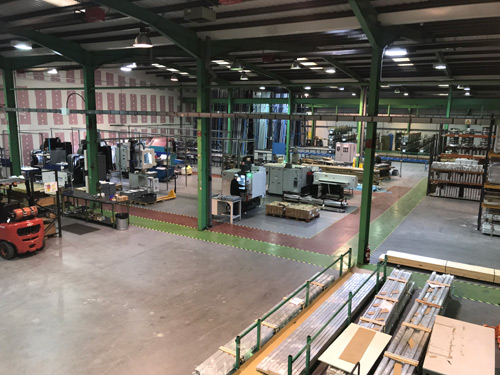
Debar Bi-fold Hardware have recently celebrated a move to new premises with a customer open day, where over 50 customers were given an in-depth tour of the new premises before enjoying lunch and the official opening of the premises by the Lord Mayor of Bradford, Councillor Abid Hussain.

Bradford based Debar are manufacturers of hardware components for bi-fold door systems and have invested over £500,000 to bring manufacturing in house to produce their own hinges, rollers and guides, using the very latest technology. The company employs over 50 people, doubling its number of employees since 2016, with the move creating 11 jobs to date and further positions being advertised.

Debar outgrew its previous premises, which was spread across five smaller industrial units. Debar were looking for the opportunity to bring everything under one roof.

Graham Fawthrop, managing director of Debar commented: “There has been a lot of hard work and effort put in by all members of the Debar team to reach the point we have today. The move to our new premises has provided a great opportunity to celebrate everyone’s involvement and to show our customers how our investment has paid off.”

The post From design to manufacture appeared first on Glass & Glazing Products Magazine (GGP).

BREXIT NO BARRIER TO SALES SAYS PIONEER’S FRENCH CUSTOMER

With Pioneer continuing to supply conservatories to a French home improvement specialist based near Paris at a rate of two articulated truck loads a month, Brexit will not present any barrier to sales, say both supplier and customer.

Sales of Pioneer’s ‘English Conservatories’ continue to grow to several International customers, including those located in countries as diverse as Japan and France and MD Danny Williams, a committed Brexit supporter, says that none of his customers see any issues with business continuing as usual after the March 2019 exit date for Britain to leave the EU: “If anything trade with Japan might even get easier but our French customer, who has been taking around 150 conservatories a year from us for the past 6 years, says that unless huge barriers are imposed, they don’t see why anything should change.”

The issue was discussed some time ago and was revisited again recently, the outspoken trade fabricator revealed: “Of course it was discussed with our French customer and our other mainland European customers when Brexit was first voted for,” explained Danny. “We addressed the issue again more recently, now that we are just a year away from leaving the EU. They tell us that unless ridiculous tariffs and physical barriers are imposed they see no reasons to change, which is exactly our position. Our customers are entirely pragmatic about the political situation, and our French customer especially is continuing to enjoy growing sales of our conservatories to their customers, who buy them in standard sizes and install them themselves.”

Danny has been vocal since the Brexit vote became clear, being especially critical of politicians’ handling of the negotiations for the terms under which Britain will leave the EU: “The inept way in which our politicians are handling the so-called negotiations is likely to have a far more damaging effect on business both at home and abroad, than anything leaving the EU is likely to have,” insists Danny. “In the meantime we continue to do very well with sales of windows and conservatories in various European countries as well as countries around the world.”

Stevly Windows Impressed By Capabilities Of Haffner Murat’s Smr-4 Welder

South Wales fabricator and installer Stevly Windows Ltd has just invested in an SMR-4 Welder from Haffner Murat. The machine will help Stevly meet growing demand for its products while also maintaining the high standards on which the company has built its name.

Lee Johnson, Stevly’s Managing Director, says he and his team researched the market thoroughly before deciding to invest in the SMR-4 welder. Lee commented: “We chose Haffner Murat due to the high specification and fully automatic facilities that the welder offered.”

Haffner has a reputation for the quality of its service and there was no exception in Stevly’s case. Lee said: “Dealing with Haffner Murat was an easy process.  Any enquiries were answered promptly and efficiently and they ensured that all our requirements were met down to the actual day of delivery.”

Lee is delighted with the latest addition to Stevly’s production facility: “Our production has become far more streamlined with the introduction of the new SMR-4 welder and the accuracy of the frames superb. The welder is much easier to use than previous machines we have installed due to the self centering facility feature.”

Stevly manufactures and installs all types of double and triple glazing including casement windows, tilt and turns and vertical sliders as well as PVC-U doors, bi-fold doors, French doors, patio doors and composite doors. It was established in 1995 and has been going from strength to strength ever since. In the past 15 years, its manufacturing facility has increased in size ten-fold and the company continues to grow. 

Dave Thomas, Managing Director of Haffner Murat, commented: “The SMR-4 Welder is an impressive machine that delivers exceptional value for money because it delivers efficiencies of 30-40% over its rivals. I’m delighted to see how Lee and his team are using it to build on the quality for which they’re known.”

www.haffnermurat.com