Major Installer Cements Relationship With Polyframe

A leading commercial installer has toasted to its long-standing alliance with Polyframe and is seizing all the benefits of working alongside the UK’s largest PVC-u fabricator, which now offers the industry’s widest range of PVC-u systems.

The Window Company has been sourcing multiple PVC-u systems from Polyframe for more than five years and has driven growth within its business by taking advantage of the unique strengths and skills of Polyframe and its experienced team. The company is now looking forward to greater business opportunities from the recently-enhanced fabricator.

David Thornton, who set up Chelmsford-based The Window Company nearly 20 years ago, says: “We have always been a commercial installer and now have 24 fitting teams installing at least 300 frames a week. In the commercial sector, you have several trades relying on you and there is a huge amount of planning involved to ensure jobs run smoothly. The quality of products and reliability of supply is fundamental to the success of an installation and we only work with suppliers that can meet our exacting requirements and won’t let us down.

Polyframe has worked in partnership with us for many years and has been an enormous asset to our business. We began working with Polyframe because it is a large, well established fabricator with a superb choice of quality PVC-u systems and a solid reputation for delivering a flexible service and a tailored support package that works for customers. We know that we can depend on them to deliver on every job and, even if products are coming from different factories, we know they will arrive on time and in full.

People make Polyframe what it is. The whole team at Polyframe shares a passion for our business and we have a great working relationship with our dedicated account manager which helps ensure that every project runs as it should do. We’re delighted to celebrate our long relationship with them and we’re already making the most of the strengthened Polyframe offering.”

Since its merger with Customade earlier this year, Polyframe now offers five PVC-u systems from Veka, Halo, Eurocell, Rehau and Duraflex. The Window Company currently sources Rehau and Halo systems from Polyframe, depending on the requirements of the installation.

David adds: “For greater security, we have always had a dual-sourcing policy. Rehau and Halo are well-specified systems and our fitting teams like to install them because they are fitter-friendly. With the enhanced capabilities of Polyframe, we can easily source multiple systems if the need arises, which is an advantage for us. By sourcing these systems from a larger fabricator, we also benefit from better economies of scale and we all work to pre-determined delivery days so we can plan installation schedules accordingly.”

The Window Company supplies both PVC-u and aluminium frames to many of the South East’s largest contractors, social housing providers, local authorities, schools, private developers and homeowners. As well as buying PVC-u from Polyframe, the company also sources REAL Aluminium frames from Customade Group and it has welcomed the convenience of sharing the resources of these two well-established industry specialists.

“We were very pleased when Customade and Polyframe came together to form Customade Group because it enables us to tap into a vast product range with all the support of a large group behind it. For me, it is important to work with people who understand the industry and are committed to maintaining high levels of quality and service. The merger has enhanced our productivity because we have one dedicated account manager to look after everything for us. And on the rare occasion that issues arise, they are handled quickly and efficiently,” David says.

www.polyframetrade.co.uk

10th

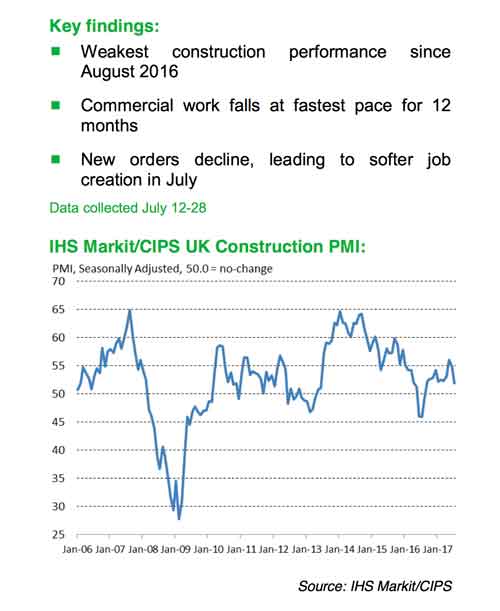
Construction growth eases to 11-month low in July

UK construction companies recorded another growth slowdown in July, reflecting lower volumes of commercial building and a softer expansion of housing activity. The latest survey also revealed a reduction in new business volumes for the first time since August 2016, which acted as a headwind to job creation and input buying across the construction sector. Intense supply chain pressures also continued in July and prices for construction materials increased at one of the sharpest rates since the first half of 2011.

Reportedly adjusted for ‘seasonal influences’, the IHS Markit/CIPS UK Construction Purchasing Managers’ Index (PMI) dropped from 54.8 in June to 51.9 in July, to signal the weakest construction performance since August 2016. The latest reading was below the long-run survey average (54.5) and pointed to only a moderate pace of business activity growth.

Tim Moore, associate director at IHS Markit and author of the IHS Markit/CIPS Construction PMI, said: “July data reveals a growth slowdown in the UK construction sector, mainly driven by lower volumes of commercial development and a loss of momentum for house building. Weaker contributions from the cyclically sensitive areas of construction activity more than offset resilience in the civil engineering sector.

“Worries about the economic outlook and heightened political uncertainty were key factors contributing to subdued demand. Construction firms reported that clients were more reluctant to spend and had opted to take longer in committing to new projects.

“There was a knock-on impact for job creation and input buying following the largest downturn in order books since August 2016. However, supply chain pressures remained intense, reflecting low stocks among vendors, and materials prices continued to rise at one of the fastest rates seen for six years.

“The combination of weaker order books and sharply rising construction costs gives concern that an extended soft patch for the construction sector may be on the horizon.”

Construction firms remained upbeat about their growth prospects, but the degree of optimism was the lowest since July 2016. This was attributed to heightened economic uncertainty and subdued confidence among clients.

Duncan Brock, director of customer relationships at the Chartered Institute of Procurement & Supply, said: “The number of new orders dropped significantly this month and at the fastest rate since August 2016, as commitment-averse clients contributed to the sector’s weak trajectory.

“Commercial building activity slowed for the first time in five months and was the main drag on the Index. Housing, the shining light of the sector eased marginally, but produced the slowest growth since April, as parallels with the darker days of Brexit, worries about the UK economy and post-election uncertainty can be seen across the construction sector.

“Continuing price pressures from the weak pound lingered, driving cost inflation near to a six-year peak, stifling purchasing activity and jobs growth. All in all, a challenging start to Q3 and there are possible roadblocks ahead for the sector in the rest of 2017, with longer lead times and suppliers struggling with stock levels, which adds insult to injury.”

Sarah McMonagle, director of external affairs at the Federation of Master Builders (FMB), said: “These figures represent the weakest monthly performance in the UK construction industry for almost one year. Construction companies are suffering from ever-increasing costs and this is starting to act as a drag on growth. More specifically, the increase in construction material prices and higher wages and salaries due to the construction skills shortages will no doubt have contributed to these disappointing results. The commercial sector in particular fell at its fastest pace for 12 months but we also saw a loss of pace among house builders. However, although the construction sector is growing at a slower pace, it is still growing and therefore there is no reason to panic.”

The post Construction growth eases to 11-month low in July appeared first on Glass & Glazing Products Magazine (GGP).

SAS LIFTS THE CURTAIN ON ITS NEW PARTNERSHIP WITH BEVAN

The UK’s largest privately-owned fenestrations systems company turned to the industry’s leading manufacturer of specialist transport solutions, for the curtainside bodies fitted to its new distribution fleet.

Doncaster-based Senior Architectural Systems (SAS) has replaced its previous vehicles with seven smartly-liveried 18-tonners, two of which pull drawbar trailers at gross train weights of up to 36 tonnes.
 
The bodywork for the Mercedes-Benz Actros and their trailers was built on the ‘standard’ production line at the St Helens factory of Supertrucks. Acquired by the Bevan Group in 2014, Supertrucks enjoys an enviable reputation for its bespoke design capability, and for the quality of the bodies and racking systems it manufactures for the glass and glazing sector.
 
The new fleet represents a major investment for SAS. The company began life in 1991 as Senior Aluminium Systems, a name it changed to Senior Architectural Systems in 2008 to reflect the expansion of its product range. Today, SAS offers a comprehensive portfolio of windows, doors and related products, with its energy-efficient PURe® and Hybrid systems key drivers behind its continued growth.
 
Although SAS has returned to Yorkshire Dealer Northside Truck & Van for another clutch of Mercedes-Benz chassis, this is the first time it has commissioned Bevan to build its bodywork. The curtainsiders are in three lengths: 9.2 metres for the trucks that work solo, 7.7 metres for the two drawbar prime movers, and 7.4 metres for their twin centre-axled trailers.
 
SAS is using its new trucks to deliver aluminium extrusions at various lengths, but typically 6.1 metres, along with palletised accessories, to fabricators nationwide. The drawbar rigs also trunk product twice a week to the company’s bases in Livingston and Newport.
 
Transport Manager Megan Hughes reveals: “Our previous bodybuilder went bust shortly after we took delivery of the last batch of vehicles, which left us without after sales support. We were particularly vigilant, therefore, when we came to select a supplier this time round.”
 
SAS whittled the potential candidates down to a shortlist of three, before coming down in favour of Bevan. “We visited the bodybuilder’s HQ in the West Midlands and were impressed by its commitment to quality,” she recalls.
 
“The design of our truck bodies is relatively straightforward, but the products we carry are heavy and can be quite cumbersome, so strength and durability are both crucial. These are still early days, of course, but it’s clear to see that our new curtainsiders are built to a much higher standard than those they’ve replaced.”
 
She continues: “We also took soundings from various other parties, and none had a bad word to say about Bevan. We’ve opted again for Mercedes-Benz chassis, but we also spoke to three other manufacturers – the verdict from each of them was that we wouldn’t go wrong if we chose Bevan.”
 
The highly responsive back-up provided by Bevan’s fast-growing Aftercare division was also an important factor in SAS’s decision. “We’ve had a couple of minor teething problems, which can happen with any new vehicles,” says Megan Hughes. “Bevan jumped on them straight away and they were quickly resolved, which is very reassuring.”
 
SAS has also been visited by the Bevan Group’s Customer Care Manager Claudia Spencer, whose role entails liaising regularly with operators to ascertain that all is running smoothly, and identify opportunities for improvement.
 
“Claudia’s certainly on the ball, professional and very helpful, as is Bevan’s Production Director Ian Roberts,” continues Ms Hughes. “On the evidence of what we’ve seen so far, Bevan’s after sales support is every bit as good as we’d been promised.”
 
The new trucks have aerodynamic StreamSpace sleeper cabs and are the subject of a Mercedes-Benz Financial Services contract hire agreement. Five are Actros 1827 models with 200 kW (272 hp) engines; the two drawbar units are 1835s with more powerful, 260 kW (354 hp) versions of the same 7.7-litre straight-six.
 
“Image is also important and our new fleet looks fantastic,” adds Megan Hughes. “We’re delighted with the vehicles.”
 
 
Twitter: @Senior_systems

ICO Issues Nuisance Calls Warning As Two Firms From Same City Are Fined

The Information Commissioner’s Office (ICO) has reminded companies making direct marketing calls that people registered with the Telephone Preference Service are “off limits”.

The warning comes as the ICO issues fines totalling £150,000 to two firms based in Bradford that, between them, sparked hundreds of complaints.

HPAS Ltd (trading as Safestyle UK) and Laura Anderson Ltd (trading as Virgo Home Improvements) broke the law when they called people who were registered with TPS.

HPAS Ltd has been fined £70,000 after the TPS and ICO received 264 complaints in 20 months. The company was repeatedly warned and placed on formal monitoring three times – but the complaints continued.

Laura Anderson Ltd has been fined £80,000 following 440 complaints in 19 months.

As well as the fines, the ICO has issued enforcement notices to both HPAS Ltd and Laura Anderson Ltd, compelling them to stop making nuisance calls or face court action.

The ICO found that neither company had subscribed to the TPS register in order to check whether the people they were contacting had opted out of receiving direct marketing. Both companies also contacted people after being explicitly told not to call again. This is against the law.

Steve Eckersley, ICO Head of Enforcement, said:

“Companies have no excuse – if people are registered with the Telephone Preference Service they are off limits.

“The law is clear and if companies fall foul of it with illegal and overly aggressive telesales tactics, we will take action on behalf of the people who suffer the nuisance.”

The ICO has had statutory responsibility for the TPS since December 2016 and received complaints about both Safestyle and Virgo from people who said that they received repeated unsolicited calls and that their opt out requests were being ignored.

Complaints about Safestyle included:

“This harassment has been going on for over five years now. I want it to stop.”

“I am disabled and pretty much housebound and he kept saying persistently that he was sending a rep around the next day. Makes me anxious as I kept saying no.”

Complaints about Virgo included:

“Angry. This is the 3rd call in two months. I have previously requested they delete our number, we are with TPS.”

“Unwanted and unneeded as we are currently dealing with a bereavement of my wife’s father, who died yesterday.”

“I was upset because the man was very disrespectful and impatient. I am retired and live on my own and it made me feel vulnerable.”

www.ico.org.uk 

8th

GGF looking forward to a ‘positive future’

The Glass and Glazing Federation (GGF) says it is looking forward to ‘a very positive future’, despite some ‘media speculation’ of internal disruption as the organisation undergoes a transitional period.

John Agnew, GGF president issued the following statement to reassure GGF members and related stakeholders that the GGF and its group of subsidiary companies are on a ‘progressive path’ to grow and serve the industry:

GGF President’s Statement:

As president and chairman of the board of directors of the Glass and Glazing Federation, I would like to highlight the positive changes at the GGF in the last 12 months.

The changes to the management structure and the organisation’s direction were unanimously agreed by the GGF board. It is worth noting that the GGF board is made up of representatives from across the main sectors of the glass and glazing industry.

GGF board directors are democratically elected by GGF members and the positions are entirely voluntarily and unpaid. In the past, some board directors have resigned due to the non-declaration of conflicts of interest. The GGF has always had firm rules in place to declare any conflicts of interest and all board members must sign this agreement before being ratified as GGF board members and at every board meeting, the chair remind all in attendance of the rules regarding conflicts of interest.

The board decisions taken and resultant changes in the past year are to be applauded as they were strong decisions made in the best interests of GGF members and the wider industry. The changes have also been accepted and welcomed by the GGF Group staff.

With the appointment of Phil Pluck as the new GGF chief executive in May this year, along with the subsequent management restructure aligned to the new additions to the GGF board, I can confidently state that the GGF and its group of subsidiary companies are now in a better position than ever before to serve GGF members and the industry.

As with most businesses during a transition period, there will inevitably be some more changes along the way, but rest assured none will be to the detriment of the GGF and its members.

With record numbers of companies joining the Federation this year, we are now looking forward to our annual members’ day next month when we will unveil the GGF’s long term strategy to help GGF members and the industry cope with the many challenges ahead.

I am pleased that all connected to the GGF and its group of subsidiary companies have so much to look forward to as the restructure takes shape to enhance all the benefits and services the GGF Group provides to the industry.

The GGF has come a very long way since its foundation in 1977 and as we mark our 40th Anniversary and reflect on the GGF’s great achievements, we also must focus on our future. The changes that have occurred in the past 12 months, will ensure our members and other stakeholders in the subsidiary companies will continue to get the best service from the industry’s main trade body.

Following some recent departures from the GGF’s parent company, the Helix Group, the interim replacements for each role have also been announced:

  • Phil Pluck, GGF CEO has now been appointed interim GGF Group CEO.
  • Brian Baker, former GGF CEO has been appointed short term interim CEO of GGF parent company, Helix Group. (This will probably be the case until early to mid-September.)
  • Kevin Buckley has been appointed longer term interim CEO of Helix Group. This will be for a period of approximately six months.
  • Tony Morgan has been appointed interim finance director.

All of the above senior managers are said to ‘bring decades of experience of running membership, commercial and not-for-profit organisations’.

Phil Pluck, GGF Group CEO commented, “The GGF Group is an important part of the Federation and the industry, I am therefore delighted that we now have a strong team in place to maintain the high levels of service our subsidiary companies provide and to build for the future.”

www.ggf.org.uk

The post GGF looking forward to a ‘positive future’ appeared first on Glass & Glazing Products Magazine (GGP).

The ideal showpiece for Lumi

When the creators of Lumi, billed as ‘the industry’s most radical new window and door system’ heard that a substantial ‘ultra-contemporary house’ was being planned not far from its head office, the opportunity seemed too good to miss. Fortunately, the owner of the property agreed, plans were drawn up and the result was not only a ‘stunning private residence’ but also ‘one of the best showpiece installations any manufacturer could wish for’.

“When we began creating the Lumi concept, our mind’s eye put it in a high-value, bespoke contemporary setting,” said Apeer MD, Asa McGillian.

“Then, when we saw that the architect’s drawings were so much like that mental picture, we could not let the opportunity pass. The result is not only a superb piece of architecture in its own right but also an absolutely ideal setting to bring out the best in the Lumi system.”

He added: “Many have been surprised since that Lumi has been chosen as a feature in classical and traditional settings as well as contemporary because it has a simplicity that makes it at home anywhere. But that same simplicity is brought to the fore in such a setting as this.”
The installation makes extensive use of Lumi windows, residential doors and sliding doors, placing them among a variety of exterior materials including white render, grey random stone and shiplap timber cladding.

Anthracite grey was chosen throughout for the Lumi exteriors, with the window interiors in signal grey. Many of the ground floor windows are single-pane floor-to-ceiling panels, calling on the high technical spec and energy efficiency that lie behind Lumi’s unique good looks. In the case of the large panes, however, the proximity of the site did also prove to be an additional bonus, as Asa explained: “At the time, these were some of the biggest panes we had produced in the system so, in some ways, it was a learning experience for us as well. Being such a short distance away however, we were able to supervise both transportation and installation very closely and at the same time gain many valuable insights that have now been integrated into our standard procedures.”

The Lumi system is as radical in its construction as in its looks, with its triple glazing bonded to an internal core of foam-filled reinforced glass fibre profiles. To the exterior, it shows uninterrupted ‘frameless’ panes of glass while the interior has a more recognisable window profile appearance with a variety of colour and grain options to match any interior.

Asa McGillian concluded: “The Lumi system has featured in projects and refurbs of many styles and sizes all around Britain and Ireland in the two years since its launch but this one still stands out as one of the best examples of everything that the Lumi system can achieve. We are all very proud of it and it almost goes without saying that the owner is as thrilled with it as we are.”

www.apeer.co.uk

The post The ideal showpiece for Lumi appeared first on Glass & Glazing Products Magazine (GGP).