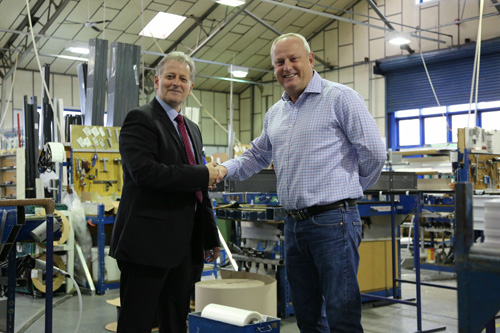
Image Above: Simon Braithwaite (left), Category Manager at Travis Perkins, with Liniar’s Business Development Director Tony Basile
Clear communication and a willingness to work together has led to the successful launch of Liniar’s roofline range in 130 Travis Perkins branches in South Wales and the South West – which is set to rise to up to 400 across the UK in the near future.
Originally formed in 1797, Travis Perkins is one of the UK’s largest builders’ merchants, supplying over 19,000 quality trade products – but there was a gap in its offering when it came to roofline.
Recognising this opportunity, Liniar’s Business Development Director Tony Basile spoke with CEO Roger Hartshorn. They formulated a plan and approached Travis Perkins with a proposal.
“When we first heard from Liniar, I wasn’t aware that the brand had a full roofline range,” said Simon Braithwaite, Category Manager at Travis Perkins. “But right from the very first meeting I was struck at the relaxed way that they operate and how well the products have been thought out.
“I was very impressed with their extrusion facility and how all the departments and teams work together to make Liniar a world class systems house!
“Everything that we’ve asked for, Liniar has delivered. The first roll out has been so successful that we are reviewing further and hope to roll out in up to 400 branches.”
Tony says: “Working with Simon and the team at Travis Perkins has been fantastic. They understood immediately what makes our roofline range different to anything currently out there, which provides the branch staff with unique selling points when promoting the range.
“At 20mm thick, instead of the usual 16mm, Liniar fascia boards provide great strength, with longer return legs and extra cover on mouldings for easier fitting.
“Liniar boards are manufactured using the latest advancements in extrusion equipment and technology to provide a consistent thickness of board with improved flatness.
“The Travis Perkins team were particularly impressed with the protective tape we have on our boards. It’s pre-marked and lined which makes it easy to find the centre line for the rafter end. The pin guides are set at 100mm centres on each line, and the lines are set at 25mm intervals.
“Should the board need cutting, installers are guaranteed a straight cut with no need to peel back the protective tape. There’s no need to pre-mark the boards which obviously saves the installer time. This also prevents the risk of scratching or damaging the boards.”
Liniar’s comprehensive roofline range incorporates capping and replacement fascias, both foam and hollow soffits, a full set of associated trims and mouldings, ventilation options and dry verge.
“The stock has been well received and the branches have been impressed with all aspects of Liniar,” said Tony. “This has been a great success because both sides have listened to what is needed and it’s fantastic to see what can be achieved.
“We’re very proud to be working with Simon and the team at Travis Perkins and are looking forward further success as the range rolls out across all the branches.”
To find your nearest Travis Perkins branch is go to www.travisperkins.co.uk.
More information on Liniar’s roofline range can be found at www.liniar.co.uk/building-products.
The chairman and managing director of aluminium specialist, CDW Systems, was recently chosen to attend a prestigious event organised by the Prime Minister Theresa May.
The event – which is called ‘The Parliamentary Review’ – took place in October at the House of Commons and was attended by political heavyweights such as Phillip Hammond MP and Greg Clark MP; as well as economic commentators like Andrew Neil.
The review is organised annually by government to assess the state of parliament and the economy; and a select handful of representatives from industry are invited to attend, to provide their input.
Due to its continued success and position as the UK’s leading specialist aluminium fabricator, CDW Systems were selected to take part in the 2016/2017 review focusing on manufacturing and services.
The chairman of the CDW, Jerry Webb and managing director, Mike Davis, both attended the event.
The review was founded in 2010 by former minister The Rt Hon David Curry, to also provide a guide to industry best practice.
Several editions focus on different policy areas and provide overviews of how each sector has responded to changes in the UK’s political and economic environment.
CDW Systems has been manufacturing and supplying aluminium windows and doors to trade, commercial and retail customers since 1992.
Alongside the gala event, a high-quality magazine is produced with a foreword from the Prime Minister and other MPs as well as a two-page feature on each company invited to attend.
Jerry Webb, commentsed: “We are thrilled that CDW Systems has joined a privileged few in this year’s Parliamentary Review. Only a handful of companies across the UK are selected to take part each year and to receive this level of recognition is a reward for what we have achieved as a team in the manufacturing and services sector.”
Mike Davis commented: “We were delighted to be asked to contribute to 2017’s Parliamentary Review and to act as an example of best practice within our sector.
“In our feedback, we have taken the opportunity to look back on the challenges we, as a business, have overcome in the last 25 years whilst also explaining how we intend to continue our growth in the future.”
You can read an online version of the review here: www.theparliamentaryreview.co.uk/editions/manufacturing-services/interior-installation
The post PM picks CDW Systems’ Jerry Web for Parliamentary Review appeared first on Glass & Glazing Products Magazine (GGP).
Infrastructure bounced back sensationally in September with six major HS2 contracts awarded on the month worth a total of £7.2 billion. However, the same can’t be said for the remaining sectors in construction, including housing which saw new orders decrease for the first time in six months.
The latest edition of the Economic & Construction Market Review from industry analysts Barbour ABI, highlights the levels of construction contract values awarded in September across all regions of Great Britain. The overall contract value for September was £6.9 billion based on a three month rolling average, the highest monthly figure for almost two years. The strong total was largely based on the commissioning of the large HS2 contracts, which made up six of the top ten biggest projects in the month (see figure 1.1), whilst also masking the pitfalls across other sectors of construction.

(Figure 1.1)
Across the industry, project numbers were down in September by 28.5% when compared to August, which was spread right across the various sectors of construction. Housing saw the biggest drop in contract values, decreasing to £1.8 billion, a 33 per cent drop on the month after consistently high growth since May and has up to now been construction’s most reliable source of high contract values over the course of 2017. Outside of Infrastructure, the only two other sectors that saw growth were Hotel, Leisure and Sport with minimal growth of 0.9% compared to August, and Medical & Health which increased by 10.4%.
Outside of the six HS2 projects, the £300 million Old War Office Building residential development in Westminster was the highest value project for September. This is followed by a new Amazon distribution centre in Bristol with a construction cost of more than £200 million – four times higher than the value of any other industrial project on the month.
Regionally, the West Midlands was the leading region for construction contract value with 35 per cent of the total, followed by London and the East Midlands with 28 and 15 per cent respectively, the three regions with HS2 contracts. The remaining regions counted for 1-4 per cent individual share of the monthly total contract value.
Commenting on the figures, Michael Dall, Lead Economist at Barbour ABI, said: “It was an unusual month for construction in September due to the £7.2 billion HS2 contracts, drastically boosting construction figures and depicting a strong, healthy industry, whereas without the six major contracts it was a poor month for contract values, highlighted by the housing sectors uncharacteristic decrease.”
“Nevertheless the HS2 projects will be a major boost to the workforces in the three located regions, providing thousands of jobs and sub-contracting opportunities.”
For more information, go to www.barbour-abi.com or follow on Twitter @BarbourABI for all the latest construction data news.

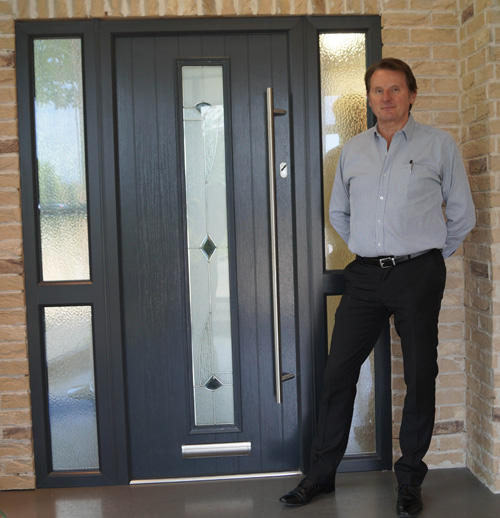
Haydon Statham with the Meridian Door
Phoenix Doors, part of Masco UK Window Group, reports that it is ceasing production of PVC door panels from mid-November 2017, to focus on its successful composite door manufacturing operation.
Commenting on the ‘strategic commercial decision’ to cease panel manufacturing, Haydon Statham, sales director at Cambridgeshire based Phoenix Doors said: “It’s a purely commercial decision and we looked long and hard at doing this because in our heyday we were making up to 1,500 panels per week. More recently this had dropped to around 800.
“Losing panel manufacture will free up the space, time and manpower in our bigger Huntingdon factory to concentrate on rising demand for our composite doors, which we introduced in 2008. Since then, composite door sales have continued to go up and they are our future.”
Saying ‘goodbye’ to the PVC door panel, Haydon added: “Having worked with PVC door panels for 16 years, 11 of those with Phoenix, it’s a sad thing for me, but good in other ways. Phoenix was started and built up on manufacturing panels. Subsequently entering the composite door market in 2008 has taken the company to where it is today.
“We see composite doors as a growing part of the market for the next three to five years. Our composite door sales continue to grow rapidly with existing and new customers selling more and there are still markets that we can tap into. It’s onward and upward for Phoenix!”
Phoenix Doors was founded as Phoenix Door Panels Ltd by Neil Peck in 1993 manufacturing PVC door panels. Composite doors were added to the range at the end of 2008. The company was acquired by Masco UK Window Group in 2013.
The post Phoenix Doors pulls out of PVC door panel manufacturing appeared first on Glass & Glazing Products Magazine (GGP).
The skills gap represents the major challenge for the glass processing and glazing sectors as increasing automation of process and generational change creates a deficit in traditional skills.
The warning was made last week at a special industry forum, held in London and organised by Bohle, to discuss the key issues shaping the glass processing and glazing sector.
The skills deficit and limited training and development opportunities for new entrants to the sector were highlighted as the single biggest challenge for glass processors and glaziers.
1st Glass & Mirror’s David Simberg, warning that quality remained a challenge for the industry because of the erosion of traditional skills sets as a generation of glass processors moved out of the industry.
This was echoed by Vince McDonnell, Glass Designs, who attributed the decline to the increasing automation of process. He argued the focus on volume production had accelerated this trend.
Paul Rogers, Express Glazing, also picked up on the theme. He said: “We need a consistent and standardised training programme, raising the skills set right across the industry. This would give businesses the confidence to invest because everyone is investing – you aren’t simply training people for someone else”.
Philip Pinnington, Glass & Glazing Federation, said the GGF was working with training providers to align training programmes to industry requirements. He picked up on a point also raised by other members that the industry was also struggling to attract new blood, suggesting it should be targeting ‘career-switchers’ as well as school and college leavers.
Despite this, those attending said that they were nonetheless, confident about the industry’s future, citing Brexit as a not necessarily welcome but far more a ‘bump in the road’ than anything catastrophic.
Glass Design’s Billy Perry, reporting that delays to major London commercial and new build contracts meant that order books remained healthy. He added: “What’s also been happening recently is that we are being asked by existing customers who we have worked with inside London to tender on projects outside of it, for example Manchester.”
The forecast slowdown in foreign investment in London had also not materialised, with many central London developments being sold almost entirely to overseas investors.
Nonetheless, those attending the forum said that they expected the toughening of economic conditions that had accompanied Brexit to continue for the foreseeable future. This had led to a ‘turning down of the temperature of the London market”, according to Rogers.
Putting Brexit to one side, continuing innovation in glass technology was seen as a key driver of future growth including multi-laminates, security, acoustic and painted glass.
The integrity of the supply chain was also seen as important. The Glass Wipeboard Company’s Aaron Dewhurst, suggesting that corporate and commercial clients were increasingly expecting their supply chain to deliver ‘green credentials’.
“One of the things we believe we’re going to see more of, is bigger commercial clients and end users expecting their suppliers to be able to demonstrate what they’re doing to minimise the impact of their business on the environment.
“For example, we’re currently working to reduce our CO2 footprint and collating figures on waste and recycling rates because the companies we’re working with are asking for it and it’s going to be key to winning future business.”
Commenting on the event, Bohle’s Dave Broxton, said there was clear and continuing confidence amongst glass processors.
He said: “The mood still very positive. London continues to provide wide-ranging opportunities and well organised and run businesses are continuing to take advantage of them.
“What is, however, clear is that the industry needs to do more to address the skills gap that increasing automation of process and generational change has created.
“This isn’t unique to our industry and is something which can only be delivered through effective partnership between business, the industry’s representative bodies and government.”
The post Skills gap ‘bigger threat than Brexit’ says glass industry forum appeared first on Glass & Glazing Products Magazine (GGP).
‘Joinery manufacturers having to think on their feet as sales volumes rise but costs continue to increase‘
The British Woodworking Federation’s Joinery State of Trade Survey Q2 2017 has indicated that although rising raw materials costs and labour availability are exerting pressure on joinery manufacturers, the industry is optimistic over sales figures and product investment opportunities.
BWF Policy and Communications Executive Matt Mahony commented on the state of the joinery industry: “With optimism over sales volumes and with order books holding up well, our survey paints a picture of an industry working hard to protect its margins against significant cost rises. It has been a theme of recent months that the joinery industry is having to think on its feet and diversify its offering. We know from the Q2 survey that investment in product improvement has been rising, and anecdotal evidence suggests that companies are taking on more of the burden of design and specification on account of knowledge gaps within the supply chain.
“Broader construction industry information supports our findings. The Construction Products Association (CPA) has reported that UK construction product manufacturers are experiencing continued growth in activity but high input costs and uncertainty have dampened expectations for the near future. Our story is more positive. After a mixed start to 2017 for joinery, 42% of respondents noted an increase in sales from the previous quarter with almost two-thirds expecting improved sales volumes for Q3. There are challenges out there. Labour availability remains a factor with skills shortages within the sector contributing to increased wage bills. In addition to this almost all BWF members noted that raw material costs are now a significant inflationary factor for unit costs. Joiners, not least BWF members, are natural problem solvers both on site and off and we will be working hard with members to ensure that they are capable of addressing these challenges.”
Key points from the BWF Joinery State of Trade Survey Q2 2017 include:
– A balance of 42% of respondents reported an increase in sales volumes over the last quarter, with 52% reporting an increase over the last year. This corresponds with the 14% of respondents reporting a quarterly increase in the previous survey.
– Manufacturers felt that sales volumes would improve in the next quarter, with a balance of 61% predicting an increase for Q3 2017 and a balance of 60% predicting an increase over the next year.
– 42% of companies reported a current order book of future work extending beyond 3 months – up 13% from the previous quarter – with 41% saying that their order book extended from between 1 and 3 months.
– ‘Labour Availability’ was listed as the most likely constraint on output by 27% of respondents. ‘Demand’ and ‘Capacity’ came next, with 25% and 20% of respondents feeling that they were most likely to constrain output.
– 38% of respondents on balance reported increasing their labour force in the last year, with 50% of respondents anticipating an increased labour force over the next year.
– Raw material costs were noted as an inflationary factor for unit costs for 97% of respondents, with wages & salary increases pushing up unit costs for 76% of respondents on balance.
– Exchange rates were a factor in inflating unit costs for 63% of respondents.
– Over the previous year a balance of 64% of respondents had invested in improving their products with 60% investing in their plant/equipment.
– Investment in in product improvement was set for the highest capital investment over the next year, with a balance of 70% planning to invest and with 60% set to invest in plant/equipment.
As a benefit of membership, British Woodworking Federation members can view the full BWF State of Trade Survey plus the latest economic reports produced by the Construction Products Association industry forecasting team.
The post BWF State of Trade Survey released appeared first on Windows Active Magazine.
London and South East Region
£Salary dependent on experience,
Company Car
Performance related benefits.
The Folding Sliding Door Company is a rapidly expanding and thriving organisation, leading the way in innovation and quality in the world of bi-folding doors. We now seek to appoint an energetic, driven, sales professional, to join our highly successful commercial sales team.
This role centres on the active sale, of our comprehensive product range, across the trade, commercial and contracting sector. You will build new, and extend existing, relationships with clients, identifying and reviewing their specific requirements for folding sliding (bi-fold) door systems. You will offer and sell the appropriate products from our range, which are in line with the client’s project brief.
You will create, manage and maintain, a portfolio of significant accounts and provide any necessary technical support to clients where needed.
Comprehensive training on our full range of products will be given.
Summary Person Specification-
Apply, by sending your full CV, to:
Annette Emanuel, Human Resources Manager
annette.emanuel@foldingslidngdoors.com
The post Regional Field Sales Manager appeared first on Glass & Glazing Products Magazine (GGP).
I read somewhere that the latest Insight Data market report didn’t show anything paradigm shifting (I’m paraphrasing), but I disagree. There’s plenty to chew over when you look at the finer details. I have already covered two of the areas on DGB last week:

It might appear on the surface that the report doesn’t give us any overwhelming good news. Indeed, the report shows that in a lot of areas of fabrication, the industry is on the decline in a big way. More consolidation than anything else. Too many companies for the levels of demand out there. And that the major growth markets are probably now peaking and starting to find an acceptable level.
And one of the biggest disruptors in the marketplace right now are trade counters and their changing of how the industry physically buys it’s windows, doors and other fenestration related products.
But I think if there was any doubt that the industry had also grown in the past few years, then the installer numbers highlighted by this report should dispel that. Take a look at these figures from 2008 to 2017:
To be clear, and as the title already alludes to, this is a rise of 3050 installers in just nine years. That’s nearly a third in less than a decade. I see this as proof that there are still opportunities to be had in places in this industry, and installation is one of them.
The report then goes on to give a breakdown as to the levels of business, or rather frames per week these companies install:

Note the rise in the number of installers with showrooms. I’ll focus on that little detail in another post. But on the FPW front, nearly two thirds are installing 1-25 frames per week. Small levels in reality, but lots of little makes a lot.
Where are these installers coming from though? And what does their future look like in these increasingly uncertain times?
The Insight report suggest that some of these new smaller installers are those going it alone, leaving bigger companies and setting up their own businesses. Many will be OMBs and micro-installers, hoping to expand and gain traction in their own localities.
It feels as though there has been a big push towards this kind of business in the last few years, across all industries and not just our own. We are being told the virtues of being our own boss, running our own companies and driving production forward. I see this attitude reflected in the sharp rise in the number of small installers we are now seeing.
The road ahead though is not tricky. This perhaps isn’t the easiest time to set up on your own. Rising material costs, a market flooded with new products, fabrication struggling to keep up with the pace of evolution. There are a lot of reasons to make running your own company more stressful than there were just a few years ago.
Add to that the uncertainty around the UK economy and Brexit. Every week it becomes less and less certain that the UK and the EU are going to come to any sort of arrangement. Any sort of uncertainty is bad for business, and as the UK economy starts to show signs of slowing and the disparity between wage growth and inflation growing, SME’s in in our face a balancing act to try and make it through this period unscathed.
All in all though I think this paints a pretty positive picture from an installer perspective. Whilst fabrication seems to continue to consolidate to meet changing demand, there is enough business out there for more and more installers and new companies to believe there is money to be made out there.


Recent Comments