Thermoseal Group purchases the assets of North Western Lead

Thermoseal Group, the UK insulated glass (IG) component manufacturer and supplier to the window industry for over 37 years, has purchased the stock and assets of North Western Lead adding its DecraLed decorative product range to its already comprehensive range of IG components on offer.  Decra Led® adhesive lead strip and wide range of Decra Glow® Films; Decra Bevels®; as well as infused tiles and a multitude of decorative accessories are all part of the DecraLed range which has been manufactured to highest quality standards and developed with skills honed over 60 years in the industry.

“Purchasing the DecraLed decorative product ranges was an excellent opportunity for us to add a multitude of premium products to our ever-expanding IG component range,” says Gwain Paterson, Managing Director at Thermoseal Group.

He continues: “We are a one-stop-shop for IG sealed unit manufacturers and aim to continue to expand our manufacturing operations to ensure that we are offering products which are subject to our own rigorous testing and quality control procedures. “There is a high demand for DecraLed coated products from international customers and we expect to develop this export business alongside our Thermobar and Thermoflex Warm Edge product ranges. To date, we manufacture over 50% of the products we supply which also include Perma Led Adhesive Lead which we purchased in 1999. In taking on DecraLed production of high quality decorative products we aim to strengthen the DecraLed brand by providing innovative and interesting solutions for our customers’ decorative needs.

“We have already made significant investments in a new state-of-the-art design studio in Wigan. This studio will enable us to produce bespoke designs for our customers to incorporate into their own insulated glass products. “I’d like to assure customers that we value the DecraLed range and the quality of the products and will continue to manufacture to the highest standards. “Thermoseal Group is a BSI Certified ISO 9001 company and we are now working towards the latest revised standard.”

Tel: 0845 331 3950

The post Thermoseal Group purchases the assets of North Western Lead appeared first on Windows Active Magazine.

Woodworking industry ‘working hard to protect its margins against significant cost rises’

The British Woodworking Federation (BWF) Joinery State of Trade Survey Q2 2017 has indicated that although rising raw materials costs and labour availability are exerting pressure on joinery manufacturers, the industry is optimistic over sales figures and product investment opportunities.

BWF policy and communications executive, Matt Mahony, commented on the state of the joinery industry: “With optimism over sales volumes and with order books holding up well, our survey paints a picture of an industry working hard to protect its margins against significant cost rises.

“It has been a theme of recent months that the joinery industry is having to think on its feet and diversify its offering. We know from the Q2 survey that investment in product improvement has been rising, and anecdotal evidence suggests that companies are taking on more of the burden of design and specification on account of knowledge gaps within the supply chain.

“Broader construction industry information supports our findings. The Construction Products Association (CPA) has reported that UK construction product manufacturers are experiencing continued growth in activity but high input costs and uncertainty have dampened expectations for the near future. Our story is more positive. After a mixed start to 2017 for joinery, 42% of respondents noted an increase in sales from the previous quarter with almost two-thirds expecting improved sales volumes for Q3.

“There are challenges out there. Labour availability remains a factor with skills shortages within the sector contributing to increased wage bills. In addition to this almost all BWF members noted that raw material costs are now a significant inflationary factor for unit costs.

“Joiners, not least BWF members, are natural problem solvers both on site and off and we will be working hard with members to ensure that they are capable of addressing these challenges.”

www.bwf.org.uk

The post Woodworking industry ‘working hard to protect its margins against significant cost rises’ appeared first on Glass & Glazing Products Magazine (GGP).

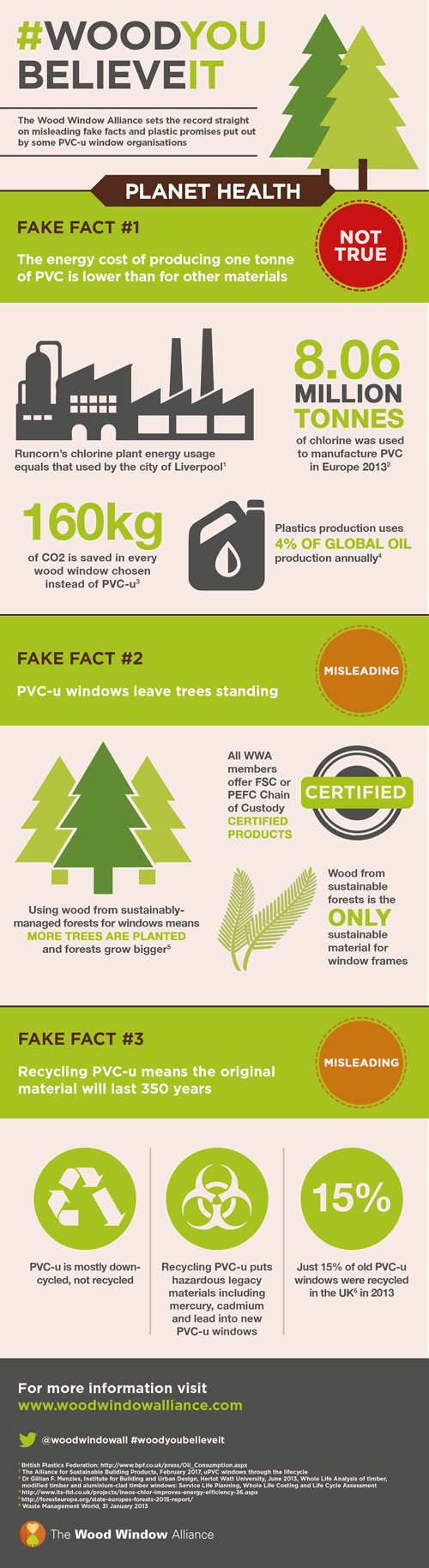
Wood Window Alliance calls time on ‘plastic promises’

The UK industry body for wood window manufacturers, the Wood Window Alliance (WWA), says it is ‘calling out’ companies ‘dressing up misleading statements as facts in order to sell more plastic windows’.

To help homeowners and industry stakeholders ‘distinguish the facts from the fiction’, the WWA is launching #woodyoubelieveit?, a campaign designed to ‘encourage consumers to think carefully about competing sales messages and about the impact of their choices on their health, homes and the planet’.

Tony Pell, chairman of the WWA, explained: “At a time when transparency is arguably in short supply, it seems that fake facts are not restricted to the world of politics, but are creeping into all manner of communications. We want to distinguish the ‘window dressing’ and ‘plastic promises’ put about by some PVC-U companies from the truth – that wood is good. In short, it’s time for true transparency in the world of windows.”

Today’s factory-finished wood windows are just as energy efficient as PVC-U, but the frames will last around twice as long. They only need repainting every 8-10 years and can be easily repaired if necessary. They are far kinder to the planet, and will add value to your home.

Pell continued: “The British public has been, and continues to be, misled about double glazing. We cannot stand by and watch people installing PVC-U lookalikes in the belief that wood is a poor alternative to PVC-U. It is not. It is the only environmentally friendly choice, one that will deliver a lifetime of beauty and energy efficiency whilst also caring for the health of people and planet.”

The WWA says its #woodyoubelieveit? campaign will present answers to the ‘fake facts’ and plastic promises to consumers through social media, media engagement, video and visual content, hoping to encourage ‘a reappraisal of the truth behind the statements made by PVC-U businesses’.

www.woodwindowalliance.com

The post Wood Window Alliance calls time on ‘plastic promises’ appeared first on Glass & Glazing Products Magazine (GGP).

Winds of Change

Image Above:  Robert Palmer

With the impact of Brexit now starting to bite, understanding long-term industry drivers is now more important than ever, according to Palmer.

The window and door industry is ‘not immune from the impact of Brexit and faces strong economic headwinds’ – that’s the warning from Robert Palmer. According to the head of the research specialist, the UK window industry faces dual challenges of a tougher second-time replacement market and wider economic uncertainty as the UK exits from Brussels.

“The post-Brexit phoney war is coming to an end and the realities of what will result in the case of a hard Brexit are now beginning to dawn”, he says.

This, he argues, is already exerting an impact on consumer confidence and with it economic growth. This slowed in the first quarter of 2017 to just 0.2% – the weakest in 12 months. “The Office for National Statistics attribute this slowing to the decline in growth to consumer facing industries and a slowdown in household spending”, Palmer says.

He adds that this has also evidenced in figures from payments provider Visa, which reported the steepest fall in consumer spending for four years this summer.   Visa also highlights a cut back in spending on big ticket items.

“This is also noted by researchers GfK which recorded a major dip in the number of consumers considering now to be the right time to make big-ticket purchases”, says Palmer.

He continues: “Consumer credit is not inexhaustible. According to the Bank of England consumer credit grew by 10.3% in the 12 months to May, higher than expected. Some economists say that consumers are confident enough to increase their borrowing.

“But the financial regulatory bodies have signalled their concerns about difficulties some consumers will have in making repayments. With inflation rising and wages static the reality is that consumers’ disposable incomes will continue to fall.”

Trends in housing are another area, which Palmer suggests may curb growth in the window and door sector in the coming year. He says: “The housing market has slowed, partly as a result of increases in stamp duty and changes in tax on second homes and investment properties and partly because of the availability of property.

“From strong double digit growth in 2013 and 2014 housing transactions barely moved in 2015 and 2016 and look set to actually decline in 2017 particularly in London, where issues surrounding affordability are most acute.

“This isn’t necessarily all bad news – some rebalancing and cooling of house price inflation is perhaps inevitable and to be welcomed, especially if more new homes can be built to ease issues of supply. The negative for the window and door industry is that there is a direct link to house moves and investment in home improvements.”

Palmer returns, however, to the argument that it is uncertainty surrounding Brexit which is the greatest threat to UK economic growth.

“The ill-fated general election is seen by some as an opportunity to soften the Brexit terms or even, though much less likely, abandon the whole process altogether. That is debatable but what it did do is to increase uncertainty. For instance how long will May remain as PM with her hard Brexit agenda? Are the soft Brexiters now in the ascendancy? And for that expected, unexpected event, who is actually in charge?”, he asks.

With a new study due for publication at the end of the summer, Palmer refused to be drawn on a detailed analysis of the window and door. He suggested, however, that tougher second-time replacement sells and the shift away from home ownership, are driving long-term changes of their own.

According to figures published by Palmer in its last report: The Window, Door and Conservatory Markets in Housing in Great Britain (Oct 2016), first time window and door replacements have dropped from 80% in 2000 to less than 30% in 2015, with ‘replacement of replacement’ installations now accounting for 70% of all installations.

He argued that this was driving increased focus on aesthetics, “Homeowners want something that is tangibly different and the appearance of windows is increasingly important in the market”, he said.

“That in turn is driving innovation in the industry and the shift to premium finishes and foils in retail markets. While there will always be a place for standard budget white PVC-U, there has been definite shift in consumer expectation.”

He added that this shift to higher end-offers was also driving growth for aluminium and significant growth in sales of aluminium bi-fold doors. He also forecasts ‘exponential growth’ in the solid roof conservatory market as a second key area of opportunity.

“This is to a degree the point”, continues Palmer, “Things are in our view going to be tougher but that does not necessarily mean that all parts of the industry will struggle. If the economy slows, as we are expecting, then, as always, high end and innovative products are more likely to weather the storm, while cheaper commodity products will become more vulnerable.”

*The new edition of the The Window, Door and Conservatory Markets in Housing in Great Britain, will be published by Palmer Market Research at the end of August.

For more information log on at www.palmermarketresearch.co.uk email info@palmermarketresearch.co.uk or call 020 83908131.

25th

Roy Frost acquires Essex based fabricator GJB

Centre front row: Ken Blackman (previous owner), Roy Frost (MD), Gary Bristow (sales director) and Mike Wolstenholme (operations director) outside the GJB factory

Centre front row: Ken Blackman (previous owner), Roy Frost (MD), Gary Bristow (sales director) and Mike Wolstenholme (operations director) outside the GJB factory

Roy Frost is back in the industry having bought prominent Eurocell fabricator GJB from previous owners Ken Blackman and Gary Bristow. Roy will assume the position of managing director, spearheading a new era of growth for the £12m turnover Essex based fabricator, while Ken Blackman will retire and Gary Bristow will continue in his role as sales director. Mike Wolstenholme also joins the company as operations director, having previously spent his career in window fabrication with Epwin Group, Everest and Jeld-Wen.

Commenting on the acquisition Roy said: “GJB is a fantastic business with a loyal customer base and I am absolutely delighted to take the reins. Operationally the business is very strong and I’m looking forward to applying some of my own ideas to take the company to the next level. Ken put his heart and soul into the business for the last 27 years and I wish him all the best in his very well-earned retirement. We’ve renewed the leases on the factory units and already have exciting plans for growth.”

Previous owner, Ken Blackman, commented: “GJB has been a big part of my life for so long it was very important to me that I left the company in the right hands. When Roy expressed an interest I immediately knew it was the perfect fit – he has the experience and ability to drive the company forward and I’m delighted we were able to strike a deal.”

Ken started GJB back in 1990 with his friend and business partner Gary Bristow, from humble beginnings in farm buildings in Stebbing they developed rapidly and moved to factory units in Rayleigh where they subsequently invested in automation to supply high-quality PVC-U windows and doors to trade clients in the South East and beyond. GJB’s firm commitment to quality and service saw the business grow into one of Eurocell’s largest fabricators, producing in excess of 1,200 frames per week.

Sales director and company founder, Gary Bristow, commented: “Ken has been instrumental in our journey from a small start-up into one of the UK’s leading trade fabricators and I would like to take this opportunity to thank him personally for his fantastic support. The acquisition is good news for GJB staff, because it gives them job security, but it’s also good news for GJB customers. Roy understands the challenges of installation and retailing in a competitive market and will bring an abundance of experience, fresh ideas plus bags of energy to the business.”

Roy Frost cut his teeth in the window industry with Everest, first as manufacturing director and then business development director, where for over a decade they created significant growth. In 2012 Roy joined PVC-U systems company, Deceuninck, as its managing director, overseeing a huge and positive transformation of the UK business and 80% growth.

Roy hinted that this acquisition of GJB could be the first of many: “There are lots of well-run businesses in this industry with owners coming up to retirement age and I am keen to explore other opportunities,” Roy concluded.

If you want to get in touch call Roy Frost on 07808 365234

www.gjbdevelopments.co.uk

The post Roy Frost acquires Essex based fabricator GJB appeared first on Glass & Glazing Products Magazine (GGP).

Window and door industry ‘not immune from the impact of Brexit’ says Palmer

Robert Palmer

Robert Palmer

The window and door industry is ‘not immune from the impact of Brexit and faces strong economic headwinds’ – that’s the warning from Robert Palmer. According to the head of the research specialist, the UK window industry faces dual challenges of a tougher second-time replacement market and wider economic uncertainty as the UK exits from Brussels.

Palmer said: “The post-Brexit phoney war is coming to an end and the realities of what will result in the case of a hard Brexit are now beginning to dawn.”

This, Palmer argues, is already exerting an impact on consumer confidence and with it economic growth. This slowed in the first quarter of 2017 to just 0.2% – the weakest in 12 months. Palmer says that the Office for National Statistics attributes this slowing to the decline in growth to consumer facing industries and a slowdown in household spending.

He added that this has also evidenced in figures from payments provider Visa, which reported the steepest fall in consumer spending for four years this summer. Visa also highlights a cut back in spending on ‘big ticket’ items.

Palmer continued: “Consumer credit is not inexhaustible. According to the Bank of England consumer credit grew by 10.3% in the 12 months to May, higher than expected. Some economists say that consumers are confident enough to increase their borrowing.

“But the financial regulatory bodies have signalled their concerns about difficulties some consumers will have in making repayments. With inflation rising and wages static the reality is that consumers’ disposable incomes will continue to fall.”

Trends in housing are another area, which Palmer suggests may curb growth in the window and door sector in the coming year. He says: “The housing market has slowed, partly as a result of increases in stamp duty and changes in tax on second homes and investment properties and partly because of the availability of property.

“From strong double digit growth in 2013 and 2014 housing transactions barely moved in 2015 and 2016 and look set to actually decline in 2017 particularly in London, where issues surrounding affordability are most acute.

“This isn’t necessarily all bad news – some rebalancing and cooling of house price inflation is perhaps inevitable and to be welcomed, especially if more new homes can be built to ease issues of supply. The negative for the window and door industry is that there is a direct link to house moves and investment in home improvements.”

Palmer returns, however, to the argument that it is uncertainty surrounding Brexit which is the greatest threat to UK economic growth.

“The ill-fated general election is seen by some as an opportunity to soften the Brexit terms or even, though much less likely, abandon the whole process altogether. That is debatable but what it did do is to increase uncertainty. For instance how long will May remain as PM with her hard Brexit agenda? Are the soft Brexiters now in the ascendancy? And for that expected, unexpected event, who is actually in charge?”

With a new study due for publication at the end of the summer, Palmer refused to be drawn on a detailed analysis of the window and door. He suggested, however, that tougher second-time replacement sells and the shift away from home ownership, are driving long-term changes of their own.

According to figures published by Palmer in his last report: The Window, Door and Conservatory Markets in Housing in Great Britain (Oct 2016), first time window and door replacements have dropped from 80% in 2000 to less than 30% in 2015, with ‘replacement of replacement’ installations now accounting for 70% of all installations.

He argued that this was driving increased focus on aesthetics: “Homeowners want something that is tangibly different and the appearance of windows is increasingly important in the market”, he said. “That in turn is driving innovation in the industry and the shift to premium finishes and foils in retail markets. While there will always be a place for standard budget white PVC-U, there has been definite shift in consumer expectation.”

He added that this shift to higher end-offers was also driving growth for aluminium and significant growth in sales of aluminium bi-fold doors. He also forecasts ‘exponential growth’ in the solid roof conservatory market as a second key area of opportunity.

“This is, to a degree the point,” continued Palmer. “Things are in our view going to be tougher but that does not necessarily mean that all parts of the industry will struggle. If the economy slows, as we are expecting, then, as always, high end and innovative products are more likely to weather the storm, while cheaper commodity products will become more vulnerable.”

www.palmermarketresearch.co.uk

The post Window and door industry ‘not immune from the impact of Brexit’ says Palmer appeared first on Glass & Glazing Products Magazine (GGP).

Construction Bounces Back After A Recent Stall In Growth

After a torrid month in May for construction, figures began to move in the right direction across June, with contract awards increasing by twelve per-cent, as a number of high profile projects were given the green light.

The latest edition of the Economic & Construction Market Review from industry analysts Barbour ABI, highlights the levels of construction contract values awarded in June across all regions of Great Britain, which totalled £5.5 billion based on a three-month rolling average, an increase on the £4.9 billion from May.

London led all regions with 26 per cent of the total construction contract value for June. This was greatly helped by the North Quay Poplar development contract award, worth £800 million, the largest project across all of construction on the month.

Across the various construction sectors, it was Residential building that produced the highest value on the month, reaching £2.5 billion, bouncing back admirably after a dip in May when it decreased to £1.7 billion. Furthermore, four of the top ten biggest projects in June came from the Residential sector. There were also monthly increases in Industrial, Commercial & Retail and Medical & Healthcare. The largest decrease came from Infrastructure, which lacked a high value project on the month to help increase its figures.

Looking at construction in June across the UK regions outside of London, the dominance continued across southern England with the South East in second place for construction contract value with £713 million awarded, followed by the South West in joint third place with the North West, each tied at £627 million.

Commenting on the figures, Michael Dall, Lead Economist at Barbour ABI, said: “The construction sector bounced back after an election-focused month in May, as the residential sector once again performed strongly, continuing the trend of it holding the construction sector steady. However with declines in value from Hotel, Leisure & Sport and in particular Infrastructure, there is continuous pressure on Residential to achieve high values every month.”

“With the Government’s increasing focus on raising the levels of major infrastructure projects, it’s surprising to see a lack of development in this sector across June. The anticipation however, is that we will see larger public sector contracts come to the forefront, such as offshore wind farms, energy plants and motorway upgrades as we continue into 2017.”

www.barbour-abi.com

£175K investment in digital at Synseal

Synseal Group reports that it has launched a new online ordering portal for the Masterdor GRP and engineered timber door ranges as part of a £175,000 investment in digital ‘customer solutions’.

Over the past six months the systems company has released a series of new digital platforms to support its customers, including an all-inclusive trade website covering the whole Synseal Group product range, a ‘streamlined’ customer service platform and an app for the Masterdor Craftsman range which uses augmented reality to help homeowners ‘design and visualise their perfect door’.

The new Masterdor portal enables customers to complete their orders online 24/7 with the ability to design both Benchmark GRP and Craftsman timber doors from scratch, including style, colour, glazing and hardware. This incorporates the whole range of 19 Benchmark and 28 Craftsman styles.

Andy Jones, group sales and marketing director at Synseal Group, said: “We’re investing in digital solutions which respond to our customers’ needs to access information quickly, easily and on-the-go. Now customers can track their queries with us online, browse our full product range in one place, and create bespoke door orders online at a time that suits them.

“The new Masterdor portal which has just gone live will make it much easier for our customers to order doors to exact specifications and to see what they look like online before completing their purchase. With the Craftsman range, we now have 28 styles in 21 colours, all available with a choice of 44mm or 54mm thicknesses with an optional thermal core – so it’s important that our customers can specify exactly what they need online in just a few clicks.

“Some of our customers make regular orders of the same products so we have designed the portal to be easy to make repeat orders; but for customers who are responding to bespoke orders from homeowners it gives them the flexibility to design online with the customer on hand if they wish, and to visibly see their final product. This is a big step forward in modernising the Masterdor brand since we acquired it two years ago, and will make a huge difference to customers who have been limited to making orders over the telephone during office hours.

“On top of this, our Craftsman AR app which we launched just a couple of months ago enables installers and homeowners to design their Craftsman doors on their mobile or tablet device, and superimpose this directly onto a customer’s home or an existing door in the showroom, making it the perfect tool for installers on the go.

“We’ve received excellent feedback from customers on our most recent digital investments and are confident they will help our customers to reduce their admin time and to improve their conversion rates.”

The new Masterdor online ordering portal is available for existing customers. To sign up, visit www.masterdorbuilder.co.uk/register. You can download the Craftsman AR app for free via the Apple Store or Google Play, or browse the full range of Synseal Group products and services at www.synseal.com.

The post £175K investment in digital at Synseal appeared first on Glass & Glazing Products Magazine (GGP).