Edgetech’s Excellence Acknowledged With G17 Nomination

Edgetech are delighted to have been shortlisted for Component Supplier of the Year at the prestigious G Awards.

The news tops off a momentous year for the Coventry company, that’s seen it not only celebrate a decade of manufacturing in the UK, but invest extensively in facilities and staff.

Back in July, Edgetech gathered local dignitaries, members of the trade press, executives from parent company Quanex, and long-standing customers and suppliers, to open a £1m extension to their HQ.

“Everyone at Edgetech is delighted that we’ve been recognised in this way,” commented Managing Director Chris Alderson. “The G Awards are the biggest and most competitive awards scheme in the industry, and even being finalists is a huge achievement.

“Coming towards the end of a year of celebration for Edgetech, it’s provided us with a valuable opportunity to look back, and see just how far both we as a company and the industry as a whole has come in a relatively short amount of time.

“Back in 2007, warm edge technology was still niche – used in as little as 5% of sealed units in the UK. Today, the market has been completely transformed. Between 70 and 80% of sealed units now incorporate a warm edge spacer – and Edgetech can take a lot of the credit for that.

“But we’re never complacent. We’re planning to ramp up UK investment even further in the months and years ahead, strengthening our position as market leaders, and are set to benefit greatly from Quanex’s new centralised R and D facility in Akron, Ohio, located ideally within close proximity to the polymer experts at the University of Akron.

“Our company is built on innovation, and we have some very exciting product developments in the pipeline. All in all, it’s an extremely exciting time for Edgetech, and our customers throughout the country.

“Good luck to all the other nominees – and we look forward to the awards night itself in November!”

For more information on Edgetech’s range of spacers and to stay up-to-date with the latest developments from the company visit: www.edgetechig.co.uk

Security Isn’t Just Skin Deep

The composite door leaf and glazing systems from Distinction Doors are major components when part of a door set and have a proven ability to achieve PAS24:2016, the industry’s enhanced security standard and a prerequisite in attaining third party certification to Secured by Design – a police initiative to protect against unlawful intrusion. This also demonstrates compliance to Document Q of the building Regulations.

Dave Walker, Technical Director at Distinction Doors, comments: “We are very proud of our door’s credentials and its ability to meet the most demanding technical requirements. What is particularly important to us is that Distinction Doors meets all these performance standards because of the overall quality and innovation in our doors.”

Dave explains: “For example, a demanding PAS 24: 2016 test element gives composite doors three minutes to survive an attack by UKAS laboratory engineers using a 6mm, 25mm chisel and or a Stanley knife in creating a 50mm diameter hole. This hole size is considered large enough to get an arm through and open the door and therefore constitutes a failure. Certain suppliers of composite doors might think the best way to protect against this was to increase the thickness of the door’s GRP skin. We believe there are better ways to do it.”

Dave points out that by increasing the GRP skin thickness there are four potential detrimental issues which fabricators should consider.

Firstly, the thermal performance/efficiency of the door will be compromised because the insulating foam core is reduced in thickness. Secondly is that GRP is an extremely hard material, and by increasing the amount used in the door leaf, it will have adverse effects in the CNC machining process of apertures, resulting in reduced tooling yield. Thirdly, any future changes to the PAS24 standard, could result in pressing tools being de-commissioned in order to carry out modifications, which could affect the supply of goods for an unspecified period of time.

Finally, by only increasing the depth of a part of the skin, there is danger that this could affect the long-term aesthetics of the door. As tooling wears through continuous use, it could start exhibiting witness/shadow lines that become evident on the skin’s surface at the junction where skins increase/reduce. This was something that Nan Ya’s experienced technical and manufacturing teams felt strongly about and were therefore very much against. It is also important to be aware that if the GRP skins have only been increased in part of the area, then it must be within the 800mm banded area (400mm above and below of the positioning of the cylinder) of Zone 1 of the attack. Should this not be the case then a sizeable proportion of door styles will be compromised and not compliant.

Dave concludes: “At Distinction Doors we believe in innovation without compromise. It is why our GRP standard Signature and revolutionary nxt-gen composite door blanks comfortably meet the latest requirements and why we remain the market leader.”

To find out more about Distinction Doors visit www.distinctiondoors.co.uk/contact-us/


nxt-gen-V1

21st

SFS Extends Specifier Support to Drive Better Quality Doorsets

Image Above: The W-Tec 3D concealed hinge from SFS, part of its range of concealed hinges for designer doors, created and manufactured to meet the needs of architects, designers and door producers, to effortlessly blend in with all door styles.

Door hinge manufacturer SFS has extended its technical support for architects, interior designers and fit-out contractors to help deliver safe, secure and compliant doorsets which take advantage of the latest hinge technology for long term reliable performance and visual appeal.

The company’s new RIBA-Approved CPD seminar is now available for bookings. Its focus on security and access for the disabled provides essential guidance on the design considerations for external and internal doorsets, and why the hinge plays a pivotal role. The 60-minute seminar recaps on the Secured by Design initiative, along with the PAS 024 security standard that underpins this, and provides practical insights into aesthetics, delivering outstanding performance, Part M and disabled access requirements, the demands of Part L and the thermal performance of windows and doors.

In addition to its new CPD seminar, SFS has also made accessing hinge product information easier, with an updated website offering downloads to all hinge technology solutions, along with direct contact information for its skilled technical team. 

SFS, which was exclusively invited to share its specification market knowledge, analysis and experience from a manufacturer’s perspective in the 2017 NBS ‘What Specifiers Want’ report, has worked closely with architects and building contractors for three decades. Its strength and depth in the specification market includes a UK-based Specification Team focused on supporting specifiers with writing NBS clauses.

David Wigglesworth, Managing Director of SFS intec’s UK business, who wrote the article in the NBS report, says: “As a designer, manufacturer and supplier of door hinges we’re well positioned to share our technical knowledge with specifiers but we know how important it is to make this information as available and useful as possible. That’s why we’ve invested in our new CPD seminar and refreshed our website.

“We were delighted to be invited to share our insights in the 2017 NBS report which will be enormously beneficial to anyone working in the specification market. The key findings of the NBS survey indicate that access to information is key, which resonates with our ethos and the way our support is structured – designed to help deliver better quality buildings and maximise client satisfaction. This is particularly so given the high proportion of specifiers who value good relationships with manufacturers and having detailed information easily accessible online.”

Expert technical support has been at the core of SFS’s success in serving the door and window market for more than 30 years with a wide range of exterior and interior door hinges, including the  Dynamic 2D range, as well as fasteners for the building envelope. Operating from its UK HQ in Leeds, the company is part of the Swiss-based SFS Group which has annual sales in excess of £1.1bn and a history dating back to the 1950s serving customers in the construction, automotive, electronics, industrial and medical products markets.

Find out more about SFS at www.sfsintec.co.uk and download the NBS ‘What Specifiers Want’ at www.thenbs.com/knowledge/what-specifiers-want-2017.

21st

Proven Passivhaus standards for Kömmerling

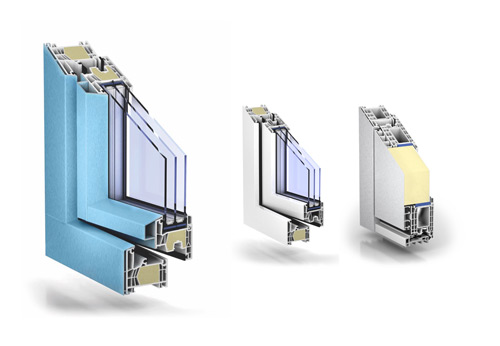
The launch of System 76 by Kömmerling at the FIT Show earlier this year, also extended to the development of a range of Passivhaus options for windows, residential doors and large span lift and slide doors, as the company looks to redefine standards of PVC-U profile performance.

For many years, says Kömmerling, Passivhaus meant window systems 85+mm in depth, but now with cutting edge design and the use of pre-foamed proEnergyTec profiles, the standard of 0.80W/(m2K) or better, can, according to Kömmerling, be easily achieved. Indeed, the centre seal variant of System 76 can reportedly achieve a ‘Uf’value of 1.0W/(m2K) as standard, with a Passivhaus capability ‘Uw’ value of 0.73W/(m2K).

There are also a number of new hybrid designs from Kömmerling which are said to bring together the ‘architectural appeal of aluminium, with the energy efficiency and cost effectiveness of PVC-U’. The latest AluClip Pro variant has been independently tested by ift Rosenheim achieving a ‘Uw’ value of 0.69/(m2K), with a flush fitting exterior aluminium section, which also offers additional structural rigidity.

As part of a range of Passivhaus options, a new inward opening residential door has been added to the range of AluClip Zero products, with a design that adopts a unique floating panel, to cope with the extremes in temperature across Europe. The renowned lift and slide PremiDoor 76 has also been independently tested achieving a UD value of 0.76W/(m2K) and again with the offer of the AluClip, aluminium exterior.

Brian McDonald, commercial manager of Kömmerling, has been involved in the introduction of these new Passivhaus products, with the company eager to open up new opportunities with architects and building specifiers. He commented: “Our range of Passivhaus solutions are unsurpassed in such a shallow frame depth, which is beneficial for the installation process, building design and for obvious commercial reasons. The proEnergyTec technology is also fully recyclable unlike most foam inserts, which further enhances our sustainability credentials.”

He continued: “With the broad range of hybrid options, we firmly believe that we are now offering some game changing products for fabricators, architects and all building professionals.”

www.kommerling.co.uk

The post Proven Passivhaus standards for Kömmerling appeared first on Glass & Glazing Products Magazine (GGP).

Low-sightlines – The New aluplast Lift-and-Slide

aluplast has added a new low-sightline fixed sash profile to its ultra-energy efficient Lift-and-Slide door, delivering increased design flexibility and end-user appeal.

Unveiled at this year’s FIT Show, the aluplast Lift-and-Slide, combines reduced manufacturing times, Passive Haus equivalent standard thermal efficiency and modular aluskin aluminium external cladding options.

The German systems house, has now expanded this UK offering with the launch of a new low-sightline option on the fixed sash of just 32mm, maximising the glazed area of the door.

Ian Cocken, Director of Sales and Marketing, aluplast, said: “The aluplast Lift-and-Slide door is about end-user appeal. It’s not a product that homeowners purchase because they need to. The soft touch lift-and-slide mechanism, the aluminium finish options combined with 27 foil colour options – this is an interiror designers dream product. It’s about aspirational appeal.

Lift & Slde“Adding an ultra-low sightline on the fixed sash creates an almost seamless connection between inside and outdoor spaces and that sense of additional exclusivity. The minute end-users come into contact and get up close to this product, they want it.

“Also offering considerable manufacturing and installation efficiencies, the aluplast Lift-and-Slide is a really high margin opportunity for fabricators and installers.”

Capable of spanning openings of 6.5m X 2.8m, the modular 85mm aluplast Lift-and-Slide system can accommodate glazing units of up to 51mm to deliver u-values as low as 0.65 W/m2K, meeting Passive Haus standards.

Delivering manufacturing time efficiencies of up to 40% over comparable systems, the aluplast Lift-and-Side employs proven easy-lift technology, effortlessly opening and closing with the lightest of touches.

It’s also available in aluskin, aluplast’s proven external aluminium facing technology. This uses an innovative ‘click-and-fix’ system to allow PVC-U fabricators to manufacture an aluminium-clad PVC-U casement window without the requirement for specialist equipment – opening-up access to new market sectors.

In addition to the aluplast Lift-and-Slide door, aluskin is also available on aluplast’s new Ideal 4000 casement window.

This modular approach and the scalability of its new Lift-and-Slide system is, according to Cocken, a key advantage. “You can take the aluplast Lift-and-Slide from its still high-end but standard specification in PVC-U and build on that. The aluplast Lift-and-Slide is just like a quality German car, you start with the basic model and then add what your customer wants to achieve all the way up to aluskin and Passiv.

“This includes the addition of foils, including flat grey finishes on grey substrate to an aluminium finish or from entry level U-values of 1.6 W/m2K all the way through to 0.65 W/m2K with very low levels of stock-holding.”

He added: “At a point of retail that’s also a real advantage because as an installation business you can price according to budget and generate opportunities to upsell product and increase margin.”

For more information please call 01684 273401 email info@aluplast.co.uk  or visit www.aluplast.co.uk.


21st

aluplast Adds Grey Substrate To Ideal 4000

aluplast has added a grey substrate option to its contemporary and highly flexible Ideal 4000 window system.

The leading-edge 70mm offer is defined by its SquareLine profile and the flexibility that it delivers, as a fully integrated product offering.

This includes aluskin, a highly innovative ‘clip-and-fix’ aluminium exterior finishing system. Building on proven technology, it allows PVC-U fabricators to manufacture an aluminium-clad PVC-U casement window without the requirement for specialist equipment – opening-up access to new market sectors.

Ian Cocken, Director of Sales and Marketing, aluplast, said: “Finish, foils and colour are key drivers of growth in the UK window industry – particularly in the second-time replacement market.

“It’s nonetheless competitive, which means that the detail matters. Given the popularity of grey foils and our launch of our aluminium external fascia, aluskin, a grey substrate option is a logical addition, allowing us to deliver a far better aesthetic and stronger retail proposition.”

aluplast foils more than 1.2million metres of product each month. That means that it holds thousands of metres of coloured and woodgrain profiles in stock, including popular anthracite grey, black, cream, rosewood and golden oak. These are available for ex-stock delivery within just days of orders.

It also offers special foils in 15-days or less with no minimum order, no surcharge and no setting up charge on special colour orders.

This includes three smooth or ‘sanded’ finish options, Basalt Grey; Anthracite Grey; and Brushed Aluminium.

“You could genuinely look at any of the aluplast smooth finishes and be forgiven for thinking that you’re looking at aluminium”, said Cocken. “The grey substrate on the Ideal 4000, joins-up that offer, delivering an even better end finish”, he continued.

Part Q approved, and achieving a WER A rating in either its’ standard PVC-U, foiled or aluskin forms, Ideal 4000 was launched by aluplast, at the FIT Show in May.

Grey substrate is the latest innovation from aluplast and follows the launch early this year of its new Lift-and-Slide door. Capable of achieving u-values as low as 0.65 W/m2K and spanning openings of 6.5m X 2.8m the modular 85mm system, delivers impressive design flexibility and is available in aluskin, as well as aluplast’s foil range.

“The number of doors and windows supplied in grey foils makes grey substrate a very subtle but important evolution of our offer”, concluded Cocken.

For more information on the Ideal 4000 or how aluplast can help your fabrication business grow call 01684 273401 email orders@aluplast.co.uk or visit www.aluplast.co.uk.

21st

Palmer warns of ‘significant headwinds’ for fenestration

Robert Palmer

Robert Palmer

Palmer Market Research’s new report into the performance and prospects of the UK window and door industry, warns of ‘significant headwinds’, with a slowdown in the housing market and uncertainty surrounding Brexit, contributing to market contraction.
Published this month [Sept], Palmer’s new market research report, The Window, Door and Conservatory Markets in Housing in Great Britain, accounts that the industry performed above forecast in 2016. This included growth of 1% in volume terms and 7% in value terms to £4.5bn, driven by a shift towards higher-end products.
This included significant growth in bi-fold doors and growing sales of foiled and mechanically jointed/timber-effect PVC-U windows, the former up 9.3% in 2016 to 42,700 door sets.
The market for windows in total grew 1.2% to 6.82million frames and remains dominated by PVC-U. This this was, however, outstripped by a 5.5% increase in installed value to £2.38bn, driven by a shift to ‘higher-end’ products.
The ‘trade-off’ to this growth was a slowing in the volume of the PVC-U market and a continuing decline in sales of timber windows – which have fallen in volume by more than 60% since 2000.
More positively, the report found that average installed prices of conservatories were up by 12%, while conservatory replacements saw growth of 6%, although this was offset by a decline in first time installations of 4%.
If the industry performed above expectation in 2016, Palmer is far less sanguine about its prospects going forward.
The report paints a complex picture defined by pockets of substantial growth but delivered against a forecast backdrop of market contraction – in volume terms at least – of 4% this year, 2% in 2018 and 1% in 2019 before a return to moderate growth in 2020.
Robert Palmer, director, Palmer Market Research, said: “The industry has out-performed our forecasts last year but we’re now seeing near stagnation in the housing market, which is a tell tail sign of tougher economic conditions to come. This and the uncertainty around Brexit has led to a weakening of consumer confidence, which we expect to bite in the second half of this year and through next.”
He continued: “This is already contributing to a level of hesitancy among housebuilders, which will make government policy and continuing investment in the Help-to-Buy scheme, increasingly key going forward.
“The social sector may be less affected by Brexit but it faces its own budgetary pressures, while we expect some funding to be diverted to the replacement of cladding and improvements to the safety of high-rise buildings in the fallout from the Grenfell Tower disaster.”
If these factors present generally unfavourable conditions, The Window, Door and Conservatory Markets in Housing in Great Britain 2017 nonetheless identifies some significant areas of growth going forward. These are for the most part defined by product and material type.
The growth recorded in bi-fold door sales and those of mechanically jointed PVC-U windows means that both are tipped for significant growth going forward as part of the general shift to higher end products. The fortunes for windows, doors and conservatories are again mixed, defined by a combination of installation and material type.
Palmer continued: “What we’re seeing is a very real shift in proposition. This in general is leading away from volume product to a higher end higher margin offer. This is defined by material type, by product and even the design of those products, for example the shift to mechanical jointing and flush casements in PVC-U.
“What is also clear is that we’re already seeing some pretty unfavourable economic headwinds and these are unlikely to dissipate anytime soon, which makes product development in the right areas a key foundation of future growth but also longer-term viability.”
www.palmermarketresearch.co.uk

The post Palmer warns of ‘significant headwinds’ for fenestration appeared first on Glass & Glazing Products Magazine (GGP).