Codifying by catastrophe…again

Jane Embury

Jane Embury

With an inquiry into the Grenfell Tower fire underway, Jane Embury, a director of Wrightstyle, has added her voice:

It’s been called ‘codifying by catastrophe.’ It’s the way in which fire and building regulations are tightened after every major fire.

The Grenfell Tower fire will be no exception, with government ministers also now having to explain why fire and building regulations weren’t tightened sooner.

At this stage, it would be wrong to point fingers of blame, although the implications of the Grenfell Tower fire have resounded around the country – and the world.

Instead, I would like to pay tribute to William Linton, whose death in a tower block fire 18 years ago led directly to a change of fire regulations.

He died in a fire in a 14-storey block of flats in Ayrshire, with the fire having spread via the external cladding, reaching the 12th floor within minutes, and destroying properties on nine floors. Four other people were injured.

The local MP, Brian Donohoe, was sufficiently concerned about cladding safety that he lobbied for a parliamentary inquiry, which was carried out by the select committee on environment, transport and regional affairs.

The report found that most external cladding being used in the UK did not pose “a serious threat to life or property in the event of fire.”

However, it added: “Notwithstanding… we do not believe that it should take a serious fire in which many people are killed before all reasonable steps are taken towards minimising the risks.”

The MPs on the committee also concluded that any addition to the outside of a building which had the “potential to lessen its resistance to external fire spread” should be subject to building regulations.

Those words, of course, date back to the start of the 21st century. But compare Westminster words with the reaction of the Scottish government. A Scottish select committee reported a year after the fire, which led to the Building (Scotland) Act 2003, which introduced the Building (Scotland) Regulations 2004 which came into force in 2005.

They state that: “Every building must be designed and constructed in such a way that in the event of an outbreak of fire within the building, or from an external source, the spread of fire on the external walls of the building is inhibited.” The word ‘inhibited’ is vital to interpreting those regulations.

Following the Grenfell Tower fire, the Scottish government convened a Ministerial Working Group to examine building and fire safety regulations in Scotland although, crucially, it confirmed that the type of external cladding reportedly used on Grenfell Tower is not present on any residential tower block in Scotland.

It seems to me preposterous that if Scotland codified by catastrophe after a fire in which only one person died, why did the Westminster government not consider a change in building regulations south of the Border?

The catastrophic Grenfell Tower fire is a stark reminder that when fires break out they can have appalling consequences. But what sets this fire apart, at least to me, is that it was a horrific event that may have been preventable if fire regulations in one part of the UK had been adopted across the rest of the UK.

At this stage, of course, we shouldn’t speculate, but it does raise uncomfortable questions for the government and all those charged with fire safety.

In the immediate aftermath, and while I’m loathe to add our voice to the swirling debate around this ghastly event, Wrightstyle has over the years repeatedly raised issues of fire safety – in the UK directly with government, and in other jurisdictions around the world, most notably in Abu Dhabi and Dubai.

We therefore have a track history of asking uncomfortable questions because our experience, based on over 20 years in fire safety, is that, while there are relatively robust regulations in place, they are often badly understood or, sometimes, simply ignored.

Another factor is that fire safety officials, in certifying new or refurbished buildings as safe, may simply have asked the wrong questions. In this case, what cladding and insulation had been fitted, and was it compliant? The answer, as we published in an article to the industry this year, is that we need better training, better documentation and better checking of documentation.

There is little doubt that further guidance will be forthcoming following the Grenfell Tower fire. But maybe what’s required, and what many of us have been arguing for some time, is a complete overhaul of building and fire regulations. At the very least, the public will expect it, and the Grenfell Tower victims deserve it.

To them, and to everyone affected, we extend our thoughts.

www.wrightstyle.co.uk

The post Codifying by catastrophe…again appeared first on Glass & Glazing Products Magazine (GGP).

Sternfenster: Setting A Unique Standard Of Quality

The premium StyleLine range, available for all Sternfenster Approved Installers, combines design innovation and pioneering manufacturing techniques. Available in a wide selection of windows and doors, this range promises to deliver more to customers.

Truly standing in a class of their own, these windows and doors are the results of Sternfenster’s continual improvement policy. Standing as the UK’s first fabricator to use the state-of-the-art Seamless Quad Welder from Graf synergy, claims the company, Sternfenster is able to offer their Approved Installers exclusive products to expand their businesses.

The revolutionary manufacturing process that these windows and doors undergo allows them to achieve unique corner grooves. Some uPVC windows and doors on the market currently feature unattractive grooved corners. However, the StyleLine range features a design that actually pushes any excess plastic back inside the frame, allowing for a beautifully seamless finish throughout.

To ensure customers are not disappointed, Sternfenster undertakes a stringent and meticulous finishing process to ensure only the highest standards of quality are achieved. This allows Approved Network Installers to offer their own customers windows and doors that provide a completely flawless design and beautiful aesthetics.

As excess plastic is pushed back into the frame, StyleLine windows and doors also offer an enhanced degree of security. No vinyl is lost at the corner joint, allowing for increased reinforcement and structural integrity of the window and door frame. This means that this range stands as an impressive foundation for home security, which can then be fitted with high security hardware.

The StyleLine range also allows Approved Installers to meet the demands of their customers, available in a wide collection of window and door styles that can be effortlessly installed into both modern and traditional properties alike. By becoming an Approved Installer with Sternfenster, you’ll be able to offer every homeowner the very best.

Mike Parczuk, Managing Director of Sternfenster, commented on the StyleLine Range:

“At Sternfenster, we are very proud of the StyleLine range and the unique standard of quality that it can offer our Approved Installers. We not only see it as an opportunity for homeowners to enhance their home with an outstanding product, it also stands as an illustration that we will always go above and beyond to achieve pioneering standards of quality. “

Approved Installers can also gain access to a high quality, professionally filmed StyleLine product video. This marketing tool has proven to be an effective and easy way to promote all the benefits of the StyleLine range in a clear, engaging and understandable way. This video can be embedded into any Approved Installer’s website for maximum coverage.

Offer your customers more by becoming a Sternfenster Approved Installer today. Give Sternfenster a call on 01522 51 25 25 or visit their website, www.sternfenster.com, for more information on how to enhance your business.

6th

UK construction sector recovery loses momentum in June

June data revealed weaker growth momentum across the UK construction sector, with business activity, new work and employment all expanding at slower rates than in May.
Survey respondents commented on signs of ‘renewed risk aversion’ among clients, reflecting concerns about the economic outlook and heightened political uncertainty. The latest survey also indicated that construction companies were the least optimistic about their near-term growth prospects since December 2016. At 54.8 in June, down from 56.0 in May, the seasonally adjusted IHS Markit/CIPS UK Construction Purchasing Managers’ Index (PMI) registered above the 50.0 no-change mark for the tenth month running. Although signalling a solid upturn in overall business activity, the rate of expansion eased from May’s 17-month peak.

Tim Moore, senior economist at IHS Markit and author of the Markit/CIPS Construction PMI, said: “The construction sector experienced a growth slowdown in June, largely reflecting weaker rises in commercial building and civil engineering activity. Residential construction work continued to increase at one of the fastest rates since the end of 2015.

“Survey respondents commented on renewed caution among clients, in response to heightened political and economic uncertainty. Fragile business sentiment led to delayed decision – making on large projects and greater concern about the outlook for workloads during the next 12 months. While construction firms remain upbeat overall about their near – term growth prospects, the degree of confidence fell to its lowest so far this year.

“Despite a softer rise in construction output, the latest survey revealed that supply chain pressures were among the most intense since early – 2015. June data also pointed to strong input price inflation, driven by resilient demand and upward pressure on costs imported construction materials.”

The post UK construction sector recovery loses momentum in June appeared first on Glass & Glazing Products Magazine (GGP).

Inspirational CMS Window Systems Secures Top 1000 UK Companies Ranking

CMS Window Systems, Scotland’s leading designer, manufacturer and installer of windows, doors and curtain walling, has once again been named as one of the best British businesses with excellent growth potential, by making the influential Top 1000 ‘Companies to Inspire Britain’ 2017 report published by the London Stock Exchange Group (LSEG).

It is the second year in a row that the company has featured in the report, which is a celebration of the UK’s fastest-growing and most dynamic small and medium sized businesses across the UK.

Based near Glasgow, CMS Window Systems has grown rapidly to now employ more than 250 people in just over a decade. It has established a unique position in the UK fenestration market through its highly sustainable, ‘closed loop’ approach to business and client projects, as well as the way it provides employment opportunities and its support for the local communities in which it operates.

CMS manufactures all its energy-efficient windows, doors and curtain walling products in a resource-efficient way, with landfill waste virtually eliminated, and it recycles all the windows and doors it extracts during replacement projects. These post-use products are separated by CMS into their constituent materials at its two recycling plants, ensuring waste PVC, timber and metal is re-processed rather than being simply sent to landfill.

CMS is one of just 41 companies in Scotland to make the Top 1000 Companies to Inspire Britain report, and one of only a handful in the windows, doors and building envelope sector. This recognition comes only a few weeks after CMS was awarded a prestigious Queen’s Award for Enterprise for its sustainable management achievements.

Andy Kerr, Managing Director of CMS Window Systems, says, “We’re delighted to be named as one of the UK’s most inspirational companies again. It’s high-profile recognition of the whole team’s continued hard work and an independent confirmation that our business development is on track as the demand for genuinely sustainable, high quality windows and doors continues to grow.”

Commenting on the report, the Rt Hon Greg Clark, Secretary of State for Business, Energy and Industrial Strategy said: “I want to congratulate the 1000 companies from across the UK featured in London Stock Exchange Group’s pioneering 1000 Companies to Inspire Britain report. Championing high growth innovative SMEs is crucial for the continued success of the UK economy and a country that works for everyone.”

Based at Castlecary near Cumbernauld, CMS Window Systems is one of Scotland’s fastest growing manufacturing businesses. Operating from a 15-acre main manufacturing and recycling facility and HQ, plus its branch in Kirkcaldy, the company provides social housing providers, housebuilders and developers with a range of high performance windows, doors and curtain walling solutions designed to maximise energy efficiency, reduce carbon emissions and deliver comfort for householders and building users.

Find out more at www.cmswindows.com

6th

Construction activity shifts across Great Britain

Contract awards on major regeneration and infrastructure projects have seen ‘hotspot’ pockets of construction emerge across Great Britain as investment in housebuilding, infrastructure and commercial shifts away from London and the South East.

The ‘Regional Construction Hotspots in Great Britain 2017’ report from industry analysts Barbour ABI and the Construction Products Association, highlights the levels of construction contract values awarded in 2016 across all regions of Great Britain, with the majority of the work taking place in 2017 onwards. A number of districts are experiencing unprecedented growth; however regionally only Scotland and the West Midlands saw any total annual growth in construction value.

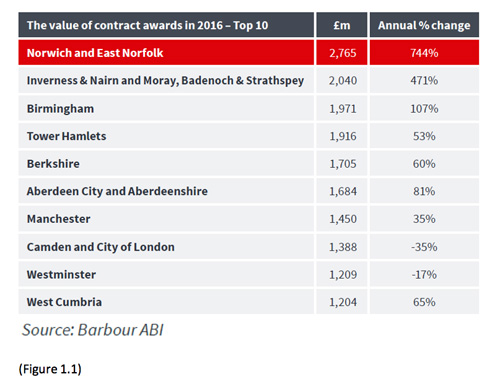
Norwich and East Norfolk led all districts across the UK in 2016 (see Figure 1.1), with more than £2.7 billion worth of construction contracts, helped greatly by the year’s largest contract award, the £1.8 billion East Anglia ONE offshore wind farm. Only two London regions made it into the top ten – Tower Hamlets and Camden and City of London, fourth and eighth respectively.
The report compared regional construction contract values in 2016 against the average of the last four years, resulting in ‘hotspots’ and ‘coldspots’ for last year’s commissioned projects in the residential, commercial and infrastructure sectors.

In past years, London dominated the ‘hotspot’ pockets of construction activity, however the report for 2016 indicates a spread across Great Britain, with London only holding six of the 61 hotspots. Scotland was the leading region with nine hotspots after doubling its contracts awarded value for infrastructure to £3.8 billion.

Birmingham was the only UK region that experienced a combined ‘hotspot’ for commercial, residential and infrastructure construction contract values last year when compared to 2015. This was primarily driven by the award of contracts for the regeneration of the city centre, including a combined 1,500 flats at the Connaught Square and Exchange Square redevelopments and high-profile new office space at Paradise Circus, Arena Central and Snowhill.

The majority of the ‘coldspots’ are clustered in the residential sector and replicated across the country, as contract award values fell from the highs registered in 2015, falling below long-term averages.

In the South East, Yorkshire & Humber and the East Midlands, one-third of sub-regions were residential coldspots. Of the 42 coldspots across Great Britain, the South East led all regions with seven of the total, all for residential. London was actually the sole region where there were no residential coldspots, with contract awards for large developments keeping values relatively unchanged from 2014 and 2015.

Commenting on the figures, Michael Dall, lead economist at Barbour ABI, said: “The government is focused on raising the levels of major infrastructure projects, in particular public sector schemes such as offshore wind farms, energy plants and motorway upgrades have considerably boosted construction value in more rural regions. Districts such as the Isle of Anglesey and Norwich and East Norfolk have experienced year-on-year construction contract value growth of 916 per cent and 744 per cent respectively.”

Rebecca Larkin, senior economist at the Construction Products Association commented: “Coldspots permeated through the residential sector last year, in a marked contrast to its strength in the previous regional report. The sector has ramped up house building activity over the last 12 months, reflecting the flow of work generated by the peak in contract awards in 2015, but there are now question marks as to what impact the fall in contract values will have on construction over the next 12 months. Monitoring contract value in 2017 will give an early indication of the sector’s near-term performance.”

The post Construction activity shifts across Great Britain appeared first on Glass & Glazing Products Magazine (GGP).

Apeer Takes The Lead With Leadership Development Plan

Apeer has launched a comprehensive Leadership Development Programme for all of its Production Team Leaders to keep the manufacturer ahead of the rapid growth it has seen in recent years.

Around 18 Team Leaders and 12 Managers and Supervisors will take part in the programme over the coming 18 months, along with a number of non-production staff.

“In a very short time, Apeer has grown into a major league manufacturer and it is important that we keep ahead of that growth with our standards and practices of management,” said Chris Wilson, who joined the Co Antrim company as Production Director at the end of last year.

“The company has not previously put our production team leaders through any management training but, to continue growing the company more effectively, we need them to take on a more strategic role, for example to be able to manage their teams to Key Performance Indicators within their specific areas.”

The programme will take the form of two streams, to minimise disruption to their conventional duties. As well as KPIs, other areas of focus will include time management, effective delegation, problem solving, project and task management, communication skills and conflict management.

Apeer has grown dramatically since the launch of its Lumi window and door system two years ago, as well as its Traditional, Contemporary and Modo composite Door collections, with production facilities and staff growing accordingly, backed by significant investment.

The Leadership Development Programme is the first major training initiative since Chris Wilson joined the company in November but he added that other areas of job-specific and product-specific knowledge such as PC Skills, Lean Manufacturing and Health & Safety may be developed in future.

www.apeer.co.uk

6th